 English
 中文简体
中文简体 русский
 日本語
日本語
Home / Newsroom / Industry News / Dual-Spindle Machining Center Explained: How It Works, Key Benefits, and What to Look for When Buying
Industry News
 Email: cnc88max@dingtalk.com
 Phone: +86-18021988367
Content
A dual-spindle machining center is a CNC machine tool equipped with two independent spindles that can operate simultaneously or sequentially on the same workpiece or on two separate workpieces at the same time. Unlike a conventional single-spindle machining center where one spindle performs all cutting operations while the workpiece remains in one position, a twin-spindle machining center fundamentally changes the throughput equation by allowing cutting, loading, and tool changing to occur in parallel rather than in sequence. The result is a dramatic reduction in non-cutting time and a corresponding increase in the number of finished parts produced per shift.
Also referred to as a double-spindle machining center, two-spindle CNC machining center, or twin-spindle CNC machine depending on the manufacturer and configuration, this class of machine tool has become increasingly central to high-volume precision manufacturing in automotive, aerospace, medical device, and consumer electronics production. The ability to simultaneously machine two parts — or to perform roughing on one spindle while finishing on the other — without doubling the machine footprint or the operator headcount makes dual-spindle machining centers one of the most compelling productivity investments available to precision manufacturers today.
The operating principle of a twin-spindle machining center varies depending on the specific configuration, but the fundamental concept is the same across all designs: two spindles share a common machine structure while maintaining independent motion control, tool changing capability, and workpiece handling interfaces. This independence is what allows both spindles to perform useful work simultaneously, unlike gang tooling arrangements where multiple tools share a single spindle axis.
In a parallel-processing dual-spindle configuration, both spindles work on identical workpieces simultaneously — when one cycle completes, both finished parts are unloaded at the same time and two new blanks are loaded, effectively halving the cycle time per part compared to a single-spindle machine with the same cutting parameters. In a sequential or handoff configuration — more common in turning center variants of the dual-spindle concept — the primary spindle performs operations on one end of the workpiece, then transfers the part to the second spindle for backworking operations on the opposite end, completing a fully machined part in a single setup without manual intervention. Machining centers in the milling-dominated sense more commonly use the parallel processing approach, while dual-spindle turning centers and mill-turn machines leverage both configurations depending on the part geometry.
A critical technical distinction in dual-spindle machining center design is whether the two spindles operate in fully synchronized motion or independently. Synchronized operation — where both spindles execute identical toolpaths simultaneously on mirror-image or identical fixtures — provides the highest throughput for symmetric part families and simplifies NC programming because a single program drives both spindles. Independent operation gives the machine controller the flexibility to run different programs, different spindle speeds, different feeds, and different tool sequences on each spindle simultaneously, enabling mixed-part production or the combination of roughing and finishing operations in a single machine cycle. High-end dual-spindle CNC machining centers support both modes, switchable through the CNC control interface, giving the shop flexibility to optimize for either maximum throughput on a single part family or maximum flexibility across a mixed production schedule.
Dual-spindle machining centers are manufactured in several structural configurations, each suited to different part families, production volumes, and floor space constraints. Understanding the key configurations helps manufacturers match the machine architecture to their specific production requirements.
| Configuration | Spindle Arrangement | Key Advantage | Typical Applications |
| Horizontal twin-spindle | Two horizontal spindles side by side | Simultaneous machining of two pallets, excellent chip evacuation | Automotive castings, structural components |
| Vertical twin-spindle | Two vertical spindles on shared gantry or independent columns | High-speed simultaneous milling of flat or prismatic parts | Small precision parts, electronics housings |
| Dual-spindle mill-turn | Main and sub-spindle with milling capability | Complete part machining in one setup, part handoff between spindles | Complex turned parts, shafts, medical components |
| Gantry-type twin-spindle | Two spindles on a common crossrail/gantry beam | Large workpiece coverage, mirror machining capability | Aerospace panels, large automotive dies |
| Opposed twin-spindle | Two spindles facing each other on common Z-axis | Simultaneous front and back machining without re-fixturing | Disc-shaped parts, thin components |
The productivity case for a double-spindle machining center is compelling when analyzed at the level of cost per finished part rather than machine purchase price. The key productivity mechanisms that dual-spindle machines deliver are fundamentally different from simply running a second shift or adding a second machine, and understanding them precisely is important for building an accurate ROI justification.
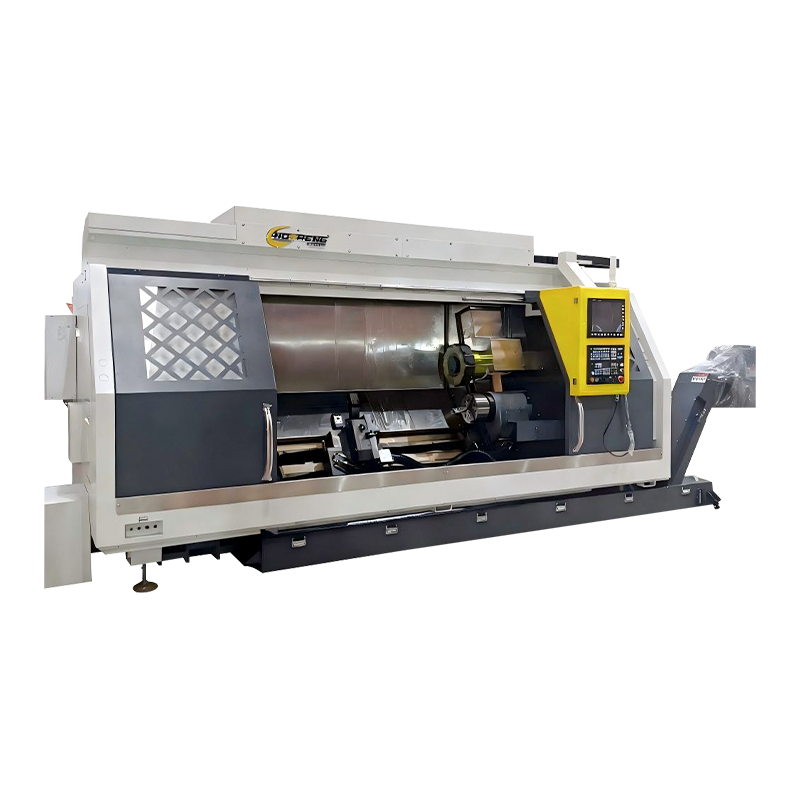
While the dual-spindle machining center concept delivers productivity benefits across a wide range of applications, certain industry segments and part families derive the greatest value from this technology. The common thread is high-volume production of relatively complex parts where cycle time reduction and setup elimination translate directly into meaningful cost per unit improvements.
The automotive industry is the largest user of dual-spindle and multi-spindle machining technology globally. Engine components including cylinder heads, engine blocks, connecting rods, crankshafts, and transmission housings are produced in volumes that make even small cycle time reductions worth millions of dollars annually at the production scale of a major OEM or Tier 1 supplier. Twin-spindle horizontal machining centers are the standard configuration for automotive powertrain lines, where pallet systems feed workpieces continuously and both spindles run synchronized programs on identical parts. Chassis components including knuckles, control arms, and brake calipers are similarly well-suited to dual-spindle production due to their near-symmetric geometries that map naturally to two-spindle parallel processing.
Aerospace manufacturing increasingly uses dual-spindle machining centers for structural components — wing ribs, spars, and fuselage frames — where gantry-type twin-spindle machines can machine mirror-image left-hand and right-hand components simultaneously, halving the machining time for structural assemblies that require large quantities of matched pairs. For smaller engine components — fuel system parts, actuator housings, and instrumentation fittings — vertical twin-spindle machining centers produce parts with the tight dimensional tolerances aerospace requires while the dual-spindle architecture maintains the production rates needed to support aircraft build programs.
Medical implants including orthopedic knee and hip components, spinal implants, and surgical instrument bodies are excellent candidates for dual-spindle machining center production. These parts are typically produced from difficult-to-machine materials such as titanium alloy, cobalt-chrome, and stainless steel, where optimizing cutting parameters on a per-spindle basis — rather than compromising to a single set of parameters for different operations — can meaningfully improve tool life and surface finish. The complete single-setup machining enabled by dual-spindle mill-turn centers is particularly valuable for complex implant geometries where multiple setups on conventional machines would introduce cumulative positioning errors incompatible with the tight tolerances of medical device specifications.
Selecting the right dual-spindle CNC machining center for your application requires evaluating a set of machine specifications that go beyond the basic parameters considered for a single-spindle machine. The following specifications are particularly important in the dual-spindle context:
Programming a two-spindle CNC machining center requires additional planning compared to single-spindle programming, even when both spindles run identical programs. Understanding the programming considerations specific to dual-spindle operation helps shops implement these machines quickly and avoid the common pitfalls that delay productivity realization after installation.
When both spindles run the same program simultaneously, the CNC control executes two channels of program code in parallel, with synchronization points — typically M-code wait commands — inserted at critical junctures where both channels must reach the same program state before either can proceed. For example, both spindles must complete their tool changes before either begins cutting, to prevent a scenario where one spindle is moving to the cutting position while the other is still in the tool change area. Mapping all synchronization requirements before programming begins, and testing the dual-channel program thoroughly in simulation before cutting air, are essential steps that experienced dual-spindle programmers never skip.
Each spindle in a dual-spindle machining center has its own set of tool length and radius offset registers. Even when identical tools are used in both spindles, the offsets must be measured and entered independently — tool length variation between nominally identical tools from the same manufacturer can be 5–20 µm, which is significant for tight-tolerance work. Presetting tools offline with a tool presetter and entering exact measured offsets for each spindle's tool population is the correct approach for precision parts. For high-volume production where SPC monitoring of part dimensions is used to manage tool wear compensation, the offset management system must be configured to update each spindle's offsets independently based on feedback from the measurement system.
Maintaining a dual-spindle machining center involves all the standard preventive maintenance tasks of a single-spindle machine — spindle lubrication, guideway care, coolant management, filter replacement — but doubled in scope and with additional considerations specific to the two-spindle architecture. The following maintenance practices are particularly important for sustaining reliability and accuracy in dual-spindle operation:

Copyright © Xuancheng Huzheng Machinery Trading Co., Ltd. Rights Reserved.