 English
 中文简体
中文简体 русский
 日本語
日本語
Home / Newsroom / Industry News / Heavy-Duty Cutting CNC Machine Tool: Types, Capabilities, Key Specs & Buying Guide
Industry News
 Email: cnc88max@dingtalk.com
 Phone: +86-18021988367
Content
A heavy-duty cutting CNC machine tool is not simply a larger version of a standard machining center. It is a purpose-engineered system built from the ground up to sustain extreme cutting forces, handle oversized or overweight workpieces, and remove material at rates that would structurally overwhelm a conventional CNC machine within minutes of operation. The term "heavy-duty" refers specifically to the machine's ability to maintain dimensional accuracy and surface integrity under conditions of sustained mechanical stress — deep cuts into hard alloys, large-diameter face milling of thick steel plates, aggressive boring of massive castings — where standard machines deflect, vibrate, and lose positional control.
The engineering difference starts at the machine structure. Where a standard vertical machining center might use a grey cast iron column with moderate wall thickness, a heavy-duty CNC cutting machine tool employs a heavily ribbed, thermally aged casting with two to four times the cross-sectional mass — or alternatively a polymer concrete (epoxy granite) base, which provides three to ten times the vibration damping of iron. This structural foundation is what allows the machine to absorb and dissipate the shock and vibration energy that aggressive metal cutting generates, keeping the tool path stable and the finished surface within tolerance even at maximum cutting parameters.
Understanding what is genuinely different — not just bigger — about a heavy-duty CNC cutting machine helps buyers avoid the common mistake of purchasing an oversized standard machine and expecting heavy-duty performance from it. The distinctions run through every major subsystem of the machine.
Standard CNC machining centers operate spindle drives in the 7.5 kW to 22 kW range, adequate for aluminum, mild steel, and moderate cutting depths in harder materials. Heavy-duty CNC cutting machine tools require 30 kW to 200 kW or more of continuous spindle power, paired with torque capacities of 500 Nm to several thousand Newton-meters at the low speeds used during roughing operations. To deliver usable torque across both the low-speed roughing range and the high-speed finishing range, heavy-duty machines commonly incorporate a two-speed or multi-speed mechanical gearbox stage between the motor and spindle — something absent from the vast majority of standard machining centers, which rely solely on the motor's torque-speed curve. This gearbox stage multiplies available torque at low RPM, enabling the machine to drive large-diameter face mills, heavy boring bars, and roughing cutters at depths of cut that a direct-drive spindle of equivalent power would stall attempting.
Standard CNC machines overwhelmingly use profiled linear roller or ball guides for their axis movements — low friction, high speed, and well suited to moderate loads and high positional accuracy. Heavy-duty CNC cutting machine tools often use box slideways, flat-and-V guideways, or hydrostatic guideways instead, or in combination with profiled guides. Box guideways provide a contact area many times larger than profiled rail guides, distributing cutting loads over a broad bearing surface that resists the shock loading of interrupted cutting. Hydrostatic guideways — where pressurized oil completely separates the moving and stationary elements — combine high load capacity with virtually zero static friction and outstanding vibration damping, making them the preferred choice for the most demanding heavy-duty applications such as large boring mills and portal milling machines used in power generation and shipbuilding.
Axis feed drives on heavy-duty CNC cutting machines must generate and sustain the thrust forces needed to advance large cutting tools through hard material at programmed feed rates. Where standard machining centers generate axis thrust of 3–8 kN, heavy-duty machines produce 20–150 kN per axis through oversized ballscrews, direct-drive linear motors in the largest gantry machines, or rack-and-pinion drives on very long-travel axes. The ballscrews themselves are significantly larger in diameter — 80mm to 160mm pitch diameter versus 32mm to 50mm on standard machines — to resist buckling under compressive cutting forces and to maintain positional stiffness when lateral forces try to deflect the axis from its commanded path during heavy cuts.
Heavy-duty CNC cutting machine tools are not a single machine type but a family of specialized machines, each optimized for a different class of workpiece geometry, size, and machining operation. Identifying the correct machine type for an application is the primary decision in any heavy-duty machining project.
Horizontal boring and milling machines (HBMs) are the most versatile heavy-duty CNC cutting machines for large prismatic workpieces — gear housings, compressor casings, pump bodies, hydraulic manifolds, and machine tool frames. The horizontal spindle allows multi-face machining through table rotation without re-fixturing, minimizing cumulative positioning errors across complex parts. Floor-type HBMs, where the spindle column travels along a floor-mounted rail, accommodate workpieces of virtually unlimited length. Spindle diameters from 100mm to 250mm, combined with adjustable facing heads, extend the machine's capability to large-diameter turning and facing operations in addition to boring and milling. These machines are the backbone of heavy engineering workshops in the power, oil and gas, and industrial machinery sectors.
Portal milling machines use a bridge structure spanning a stationary worktable, with the spindle traveling in X, Y, and Z through the gantry. This architecture provides exceptional rigidity for the very large, very heavy workpieces that define extreme heavy-duty machining — ship propellers, aerospace structural frames, large press tool molds, wind turbine main frames, and bridge structural components. Table lengths range from a few meters on smaller models to 30 meters or more on the largest production gantry mills, with worktable load ratings of 10 to over 100 tonnes. Five-axis versions with swiveling spindle heads extend capability to simultaneous contoured surfaces, enabling compound-angle features, turbine blade root forms, and aerodynamic surface shapes to be machined in single setups that would require multiple repositionings on a 3-axis machine.
Vertical turning lathes rotate a large-diameter horizontal worktable carrying the workpiece, while cutting tools mounted on a cross-rail above perform turning, boring, and milling. The vertical rotation axis makes VTLs ideal for large-diameter, relatively short workpieces — flanged rings, wheel hubs, gear blanks, pressure vessel heads, turbine rings, and large pump impellers — that are impractical to mount horizontally due to their diameter-to-length ratio. Table diameters from 1 meter to over 20 meters, and load capacities up to several thousand tonnes on the largest carousel models, cover the full range of heavy industry requirements. Gravity assists in clamping heavy workpieces on the horizontal table, simplifying fixturing and improving workholding security versus horizontal chucking of equivalent parts.
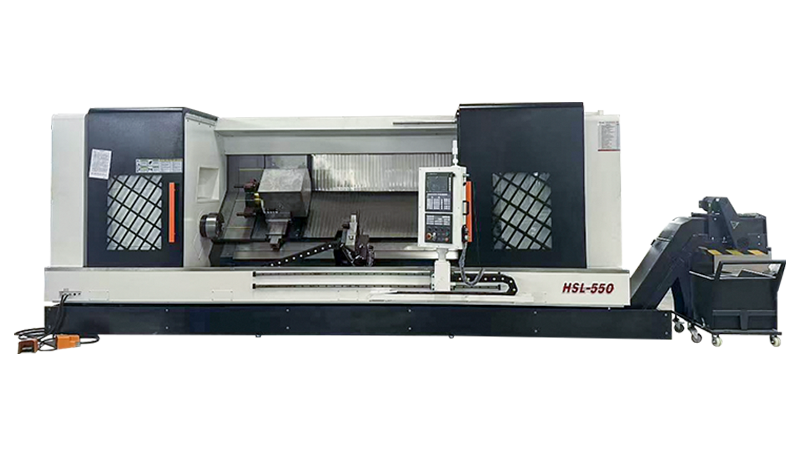
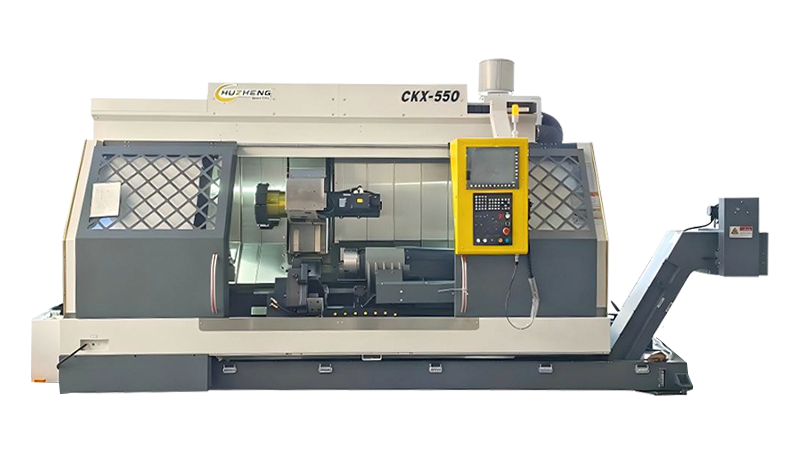
For shaft-type and cylindrical workpieces — turbine rotors, ship propeller shafts, large industrial rolls, hydraulic cylinders, and heavy-duty drive shafts — heavy-duty horizontal CNC turning centers with swing diameters of 500mm to 2,000mm and turning lengths of 1m to 20m provide the combination of high spindle torque, heavy-duty workpiece support (steady rests at multiple points along long shafts), and multi-axis simultaneous capability needed for complete part machining in a single setup. Hydrostatic spindle bearings are common on machines intended for multi-tonne workpieces, providing the load capacity and thermal stability that rolling element bearings cannot sustain at the extreme axial and radial forces generated during heavy roughing of large forgings.
The market for heavy-duty cutting CNC machine tools is concentrated in industries producing high-value, large, or structurally critical components where no lighter-duty alternative exists. These industries share common characteristics: long component service lives, stringent quality requirements, high per-part value, and workpiece sizes or materials that make standard CNC machines functionally inadequate.

Comparing heavy-duty CNC cutting machines requires systematic evaluation of interdependent specifications that together determine whether a machine will meet the production requirements of a specific application. Headline spindle power figures alone are an insufficient basis for selection — the full specification set must be assessed in combination.
| Specification | What It Indicates | Typical Heavy-Duty Range | Selection Guidance |
| Spindle power (kW) | Maximum material removal rate capability | 30–200+ kW | Size to process MRR target with 20% margin |
| Spindle torque (Nm) | Ability to cut hard materials at low RPM | 500–10,000+ Nm | Critical for large-diameter tools in hard alloys |
| Table load capacity (kg) | Maximum workpiece + fixture weight | 2,000–100,000+ kg | Include fixture weight, not just workpiece |
| Axis feed force (kN) | Maximum thrust during heavy cutting | 20–150 kN per axis | Must exceed maximum cutting force component |
| Positioning accuracy (µm) | Achievable part dimensional tolerance | ±5–±20 µm full stroke | Verify per ISO 230-2, not manufacturer claim |
| Toolholder interface | Tool rigidity and torque transmission | BT/CAT 50, ISO 50, HSK-A100/125 | HSK preferred for finishing; BT50 for roughing |
| Through-spindle coolant (bar) | Chip evacuation in deep cuts | 70–150 bar | Mandatory for titanium, Inconel, deep boring |
A heavy-duty CNC cutting machine tool cannot deliver its rated performance unless the cutting tool system is equally matched to the demands of the application. The tooling is the direct interface between the machine's power and rigidity and the workpiece material — and underspecified tooling is one of the most common reasons heavy-duty machines fail to reach their potential material removal rates in production.
Heavy-duty roughing uses indexable insert face mills, high-feed mills, and shoulder mills with carbide inserts engineered for high chip loads and shock resistance. Tangentially clamped inserts in heavy-duty face mills distribute cutting forces over a large tool body cross-section and provide more robust insert support than radially mounted designs, making them significantly more resistant to fracture under the intermittent cutting conditions common in roughing cast iron and forgings. High-feed milling cutters redirect the dominant cutting force component axially into the spindle, minimizing the bending moment on the tool and spindle and allowing extremely high feed rates per tooth even at moderate spindle power levels — making them highly effective on heavy-duty machines where the spindle's power is available but its torque or radial stiffness might be a limiting factor at large tool diameters.
Standard BT40 or CAT40 toolholders that serve adequately in general machining are a genuine performance bottleneck in heavy-duty cutting — the relatively small taper shank deflects under the high bending moments generated by deep cuts with large-diameter tools, degrading surface finish and accelerating tool wear. Heavy-duty CNC cutting machines use BT50, CAT50, or ISO 50 taper toolholders with significantly larger taper diameters and higher draw-bar clamping forces. For the most demanding finishing and semi-finishing operations, HSK-A100 or HSK-A125 hollow shank taper toolholders — which achieve simultaneous taper and flange face contact — provide dramatically higher radial and axial stiffness than conventional taper-only interfaces, with runout below 3 µm when combined with shrink-fit or hydraulic expansion tool clamping. This toolholder stiffness is the difference between a finishing pass that holds ±0.01mm tolerance and one that wanders by ±0.05mm under cutting force.
The CNC control system on a heavy-duty cutting machine is not simply a motion controller — it must actively compensate for the thermal growth, geometric errors, and dynamic instabilities that are inherent to large machines operating under heavy cutting loads. The following control functions are specifically relevant to heavy-duty CNC cutting applications and should be confirmed as available and properly implemented on any machine under consideration.
Heavy-duty cutting generates chip volumes and heat levels that overwhelm the coolant and chip management systems designed for standard machining. Getting coolant delivery and chip handling right is a precondition for achieving rated machine performance, tool life, and workpiece accuracy — and it is an area where heavy-duty installations frequently underinvest relative to the machine itself.
External flood coolant at 5–10 bar is inadequate for deep-cavity milling, long-reach boring, and any operation in difficult-to-machine alloys where chip packing and restricted access prevent coolant from reaching the cutting edge. Through-spindle coolant (TSC) systems delivering 70–150 bar through the center of the spindle and toolholder eject high-velocity coolant directly from the cutting edge, penetrating into deep cavities, flushing chips out of bores, and providing effective cooling in heavily interrupted cuts. In titanium and Inconel machining — where heat at the cutting edge is the primary tool life limiting factor — high-pressure TSC is not optional but essential, typically extending tool life two to five times compared to external flood and enabling the cutting parameters that make heavy-duty machining of these materials economically viable.
Production heavy-duty roughing of steel and cast iron can generate 200–500 kg of chips per hour. Without effective chip evacuation from the machine's work zone, chip recutting damages tool edges and workpiece surfaces, chip packing in deep cavities blocks coolant access and accelerates thermal distortion, and chip accumulation builds thermal mass within the machine structure that degrades geometric accuracy. Heavy-duty machines are built with steeply inclined bed profiles, large-capacity chip conveyors matched to chip type (hinge-type conveyors for cast iron and short-chip steel, screw conveyors for mixed swarf, magnetic belt conveyors for ferrous chips), and high-volume coolant flush nozzles that wash chips continuously toward the conveyor inlet. Chip processing equipment — coolant recovery centrifuges, chip crushers for long stringy aluminum or stainless swarf — must be sized for the machine's actual production chip rate, not an average across all operations.
A heavy-duty CNC cutting machine represents one of the largest capital equipment investments a manufacturing facility will make. The following checklist addresses the most consequential evaluation points that are frequently overlooked or under-weighted in the procurement process — any one of which, if mishandled, can result in a machine that fails to meet its intended purpose, requires expensive remediation, or demands replacement long before its design service life.

Copyright © Xuancheng Huzheng Machinery Trading Co., Ltd. Rights Reserved.