 English
 中文简体
中文简体 русский
 日本語
日本語
Home / Newsroom / Industry News / How a CNC Turning and Milling Center Boosts Your Shop's Productivity
Industry News
 Email: cnc88max@dingtalk.com
 Phone: +86-18021988367
Content
The manufacturing industry has shifted away from the traditional "lathe-then-mill" workflow toward a more integrated approach. A standard dual-spindle turn-milling center is the pinnacle of this evolution. Unlike a basic lathe, which requires an operator to manually flip a part to finish the second side, this machine features a main spindle and an opposing sub-spindle. This allows the machine to perform a "mid-air hand-off," transferring the workpiece automatically so that machining can continue on the back end without human intervention. When you combine this with high-speed live tooling, the result is a finished part that drops into the parts catcher every cycle.
By adopting a CNC turning and milling center, shops can effectively double their output per square foot of floor space. Instead of managing two separate machines and the logistics of moving materials between them, everything happens within one guarded enclosure. This drastically reduces the "work-in-progress" (WIP) inventory that often clutters shop floors, as parts move from raw bar stock to a completed state in a single continuous process.
When a part is transferred from a main spindle to a sub-spindle in a standard dual-spindle turn-milling center, the machine maintains a precise mechanical relationship between the two. In a manual setup, re-clamping a part often introduces "runout," where the features on the back side are slightly off-center from the front. The automated hand-off in a mill-turn center ensures that the centerline of the part remains constant, which is vital for high-precision shafts, bushings, and aerospace connectors.
The "milling" side of a CNC turning and milling center relies on live tool holders—essentially mini-spindles mounted on the turret. These tools allow the machine to perform off-center drilling, pocket milling, and even gear hobbing. With a full C-axis on both spindles, the machine can index the part to any degree, allowing for radial holes or angled slots to be cut with the same precision as a dedicated 3-axis or 4-axis milling machine.
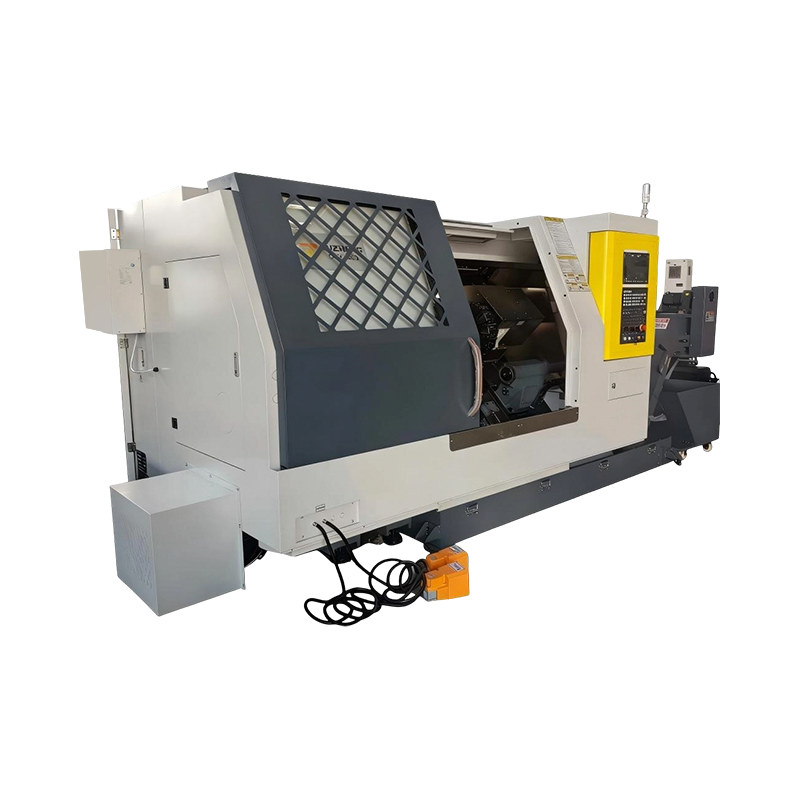
Not all turn-mill centers are created equal. Depending on your part complexity, you may need different axis configurations. Below is a breakdown of common setups for a standard dual-spindle turn-milling center.
| Configuration | Primary Capability | Best Use Case |
| Dual Spindle + Single Turret | Sequential Front/Back Work | General Job Shop Parts |
| Dual Spindle + Y-Axis | Off-Center Milling/Drilling | Valve Bodies & Manifolds |
| Dual Spindle + Twin Turrets | Simultaneous Machining | High-Volume Automotive |
| B-Axis Milling Spindle | Full 5-Axis Contouring | Complex Medical Implants |
To get the most out of a standard dual-spindle turn-milling center, shop managers should focus on balanced cycle times. This means programming the machine so that the work done on the main spindle takes roughly the same amount of time as the work on the sub-spindle. If one spindle finishes much earlier than the other, it sits idle, which wastes the machine's potential. Balancing these "wait codes" in your CNC program is the key to achieving the lowest possible cycle time.
Investing in a CNC turning and milling center is a commitment to a "one-and-done" manufacturing philosophy. While the initial learning curve for programming is steeper than a standard lathe, the long-term payoff in reduced labor, higher precision, and faster delivery times makes it one of the smartest upgrades any modern machine shop can make.

Copyright © Xuancheng Huzheng Machinery Trading Co., Ltd. Rights Reserved.