 English
 中文简体
中文简体 русский
 日本語
日本語
Home / Newsroom / Industry News / Why a CNC Turning and Milling Center is a Game-Changer for Your Shop
Industry News
 Email: cnc88max@dingtalk.com
 Phone: +86-18021988367
Content
In the world of modern manufacturing, efficiency is everything. A CNC turning and milling center, often referred to as a "mill-turn" machine, is a hybrid powerhouse that combines the rotational capabilities of a lathe with the diverse cutting functions of a milling machine. Instead of moving a part from a lathe to a separate milling station—which risks alignment errors and wastes valuable time—this integrated system allows you to complete complex geometries in a single setup. By utilizing "live tooling," the machine can stop the workpiece at precise intervals and engage rotating cutters to drill holes, mill flats, or engrave surfaces on the fly.
The real magic happens through the integration of multiple axes. While a standard lathe typically operates on X and Z axes, a sophisticated CNC turning and milling center adds Y and C axes (and sometimes a B-axis for angular milling). This allows for off-center drilling and complex contouring that would be impossible on traditional equipment. For a shop owner, this means fewer machines on the floor and a significantly faster "art to part" pipeline.
Every time a machinist moves a part from one machine to another, there is a risk of "stack-up error." Even the most skilled operator might struggle to perfectly re-zero a part. Because a turn-mill center handles both operations in one clamping, the geometric relationship between turned diameters and milled features remains incredibly tight. This is critical for industries like aerospace and medical device manufacturing, where tolerances are measured in microns.
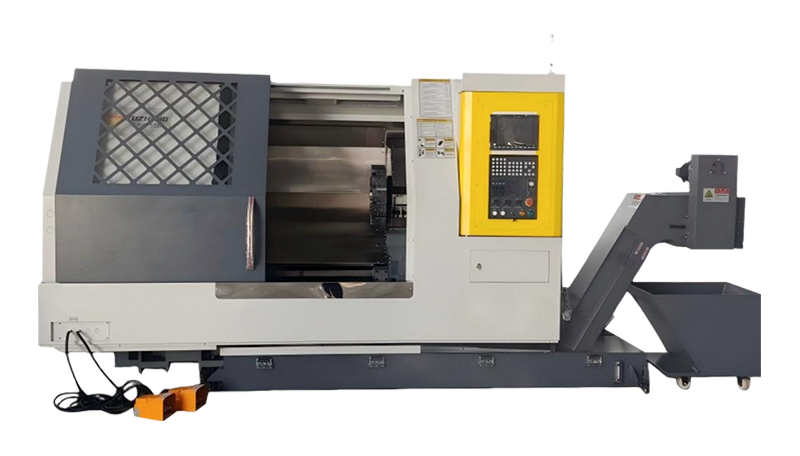
To decide if an investment in a CNC turning and milling center is right for your workflow, it helps to see how it stacks up against traditional setups. While a standard CNC lathe is excellent for simple cylindrical parts, the mill-turn variant is built for "done-in-one" productivity.
| Feature | Standard CNC Lathe | Turning and Milling Center |
| Primary Motion | Part Rotates Only | Part and Tool Both Rotate |
| Tooling Type | Static Tools | Live (Driven) Tooling |
| Secondary Ops | Requires Manual Move | Completed in One Setup |
| Complexity | Low to Medium | High / Intricate |
Where does a CNC turning and milling center truly shine? Think about any part that starts as a round bar but ends with complex features. For example, a hydraulic valve body often requires precise turning for the outer diameter, followed by deep-hole drilling and the milling of hex flats or internal pockets. Traditionally, this would be a nightmare of scheduling and fixture-making.
In the automotive sector, parts like crankshafts or specialized fasteners benefit greatly. These components require high-speed turning but also need keyways or oil holes milled at specific angles. By using a turn-mill center, manufacturers can ensure that every hole is perfectly indexed to the rotation of the shaft, ensuring flawless performance under high-stress conditions.
Operating a CNC turning and milling center requires more than just the machine; it requires the right digital infrastructure. Programming these machines is more complex than standard 2-axis turning. You will need CAM (Computer-Aided Manufacturing) software that can handle "synchronization"—the ability to tell the machine when to switch from turning mode to milling mode without crashing the tool.
Additionally, the choice of "live holders" is paramount. These holders contain the motors and gears that drive the milling bits. Investing in high-quality, high-torque live tools ensures that your milling operations are as robust as your turning. Whether you are doing light engraving or heavy-duty face milling, matching the tool's rigidity to the machine's spindle power is the secret to achieving a superior surface finish.

Copyright © Xuancheng Huzheng Machinery Trading Co., Ltd. Rights Reserved.