 English
 中文简体
中文简体 русский
 日本語
日本語
Home / Newsroom / Industry News / How Is the Standard Dual-Spindle Turn-Milling Center Transforming Precision Manufacturing?
Industry News
 Email: cnc88max@dingtalk.com
 Phone: +86-18021988367
Content
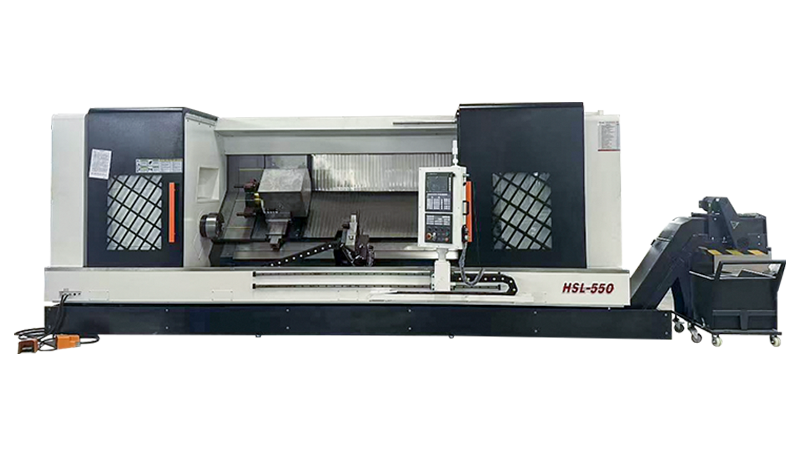
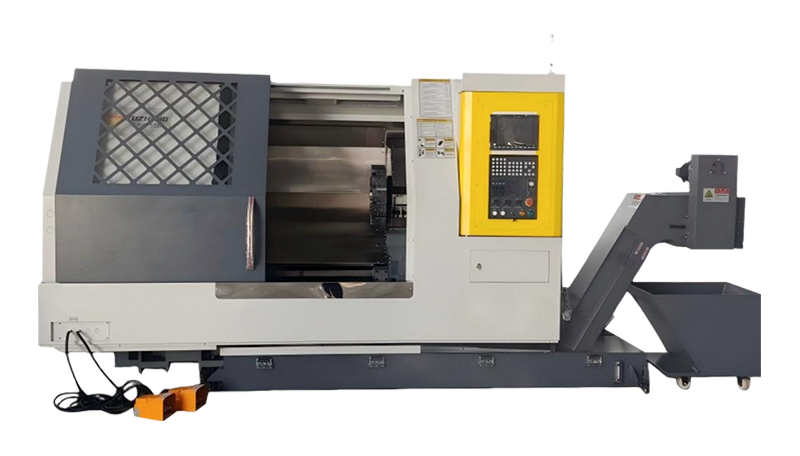
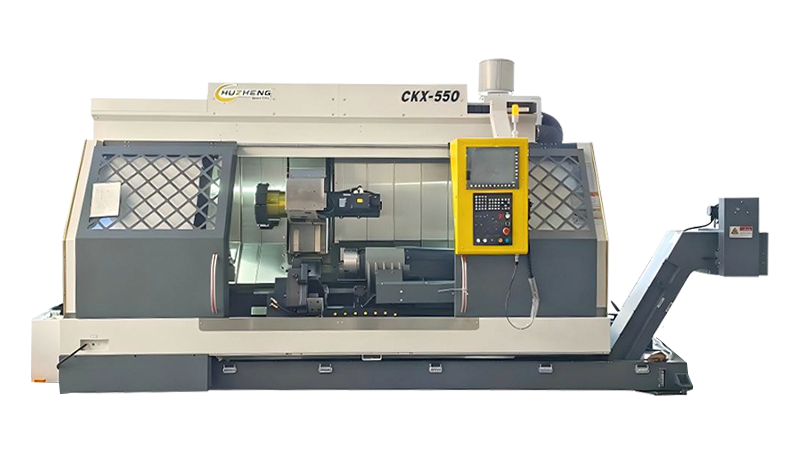
The Standard Dual-Spindle Turn-Milling Center represents a significant evolution in precision manufacturing by combining turning and milling operations within a single machine platform. Unlike traditional lathes or standalone machining centers, this system integrates two spindles—main and sub-spindle—alongside live tooling capabilities. The result is a highly synchronized production environment where complex components can be fully machined in one setup.
In practical terms, this configuration eliminates the need to transfer parts between multiple machines. Workpieces can be turned, milled, drilled, tapped, and finished in a continuous cycle. This not only improves dimensional accuracy but also dramatically reduces cumulative tolerance errors caused by repositioning and reclamping.
The defining feature of a Standard Dual-Spindle Turn-Milling Center is its synchronized spindle system. The sub-spindle receives the part from the main spindle automatically, allowing back-side machining without manual intervention. This design ensures concentricity and maintains tight geometric tolerances, especially in shaft-type and cylindrical components.
Live tooling enables milling, cross-drilling, and contour machining during turning operations. By integrating driven tools directly into the turret, manufacturers can execute multi-axis operations with high positional accuracy. This is particularly valuable for aerospace fittings, hydraulic connectors, and automotive transmission parts where multiple features must align precisely.
High-rigidity cast beds, thermal stability design, and advanced servo systems reduce vibration and thermal deformation. Stable machining conditions contribute directly to improved surface finish and dimensional repeatability, especially in high-speed production environments.
Efficiency gains from a Standard Dual-Spindle Turn-Milling Center are measurable and operationally significant. The ability to complete full-cycle machining in one clamping reduces idle time, shortens lead times, and minimizes operator involvement. In batch production, this leads to consistent cycle times and predictable output rates.
For manufacturers transitioning toward smart factories, the machine’s compatibility with automated loading systems enhances unmanned or lights-out production capabilities. This makes it particularly attractive for high-volume precision industries.
Precision manufacturing depends heavily on minimizing repositioning errors. When parts move between different machines, even minor misalignments accumulate. A Standard Dual-Spindle Turn-Milling Center addresses this issue by maintaining consistent datum references throughout the entire machining cycle.
Single-setup machining improves:
This is especially critical in industries such as aerospace and medical device manufacturing, where tolerance requirements often fall within microns.
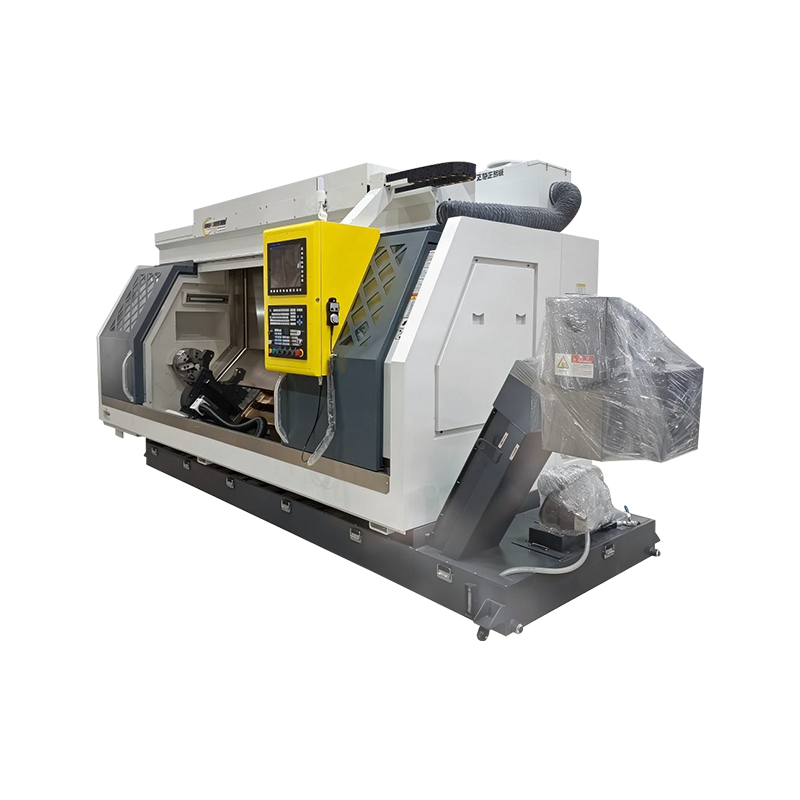
The Standard Dual-Spindle Turn-Milling Center is not a theoretical upgrade; it directly addresses production challenges in multiple industrial sectors. Below is a comparison of its applications:
| Industry | Typical Components | Key Machining Requirement |
| Automotive | Transmission shafts, connectors | High-volume precision and repeatability |
| Aerospace | Fittings, bushings | Tight tolerances and surface integrity |
| Medical | Implant components | Micro-level accuracy and finish |
| Energy | Valve parts, couplings | Durability and dimensional stability |
In each sector, the machine’s ability to perform compound machining operations without repositioning provides measurable quality and productivity advantages.
Although the initial investment in a Standard Dual-Spindle Turn-Milling Center may be higher than that of a conventional lathe, the long-term return on investment is driven by reduced labor, shorter production cycles, and lower scrap rates. Consolidating multiple operations into one machine decreases floor space requirements and simplifies workflow management.
Manufacturers also benefit from reduced quality control costs. Since parts are completed in one cycle, inspection procedures become more streamlined, and fewer dimensional inconsistencies occur. Over time, these cumulative savings offset the capital expenditure.
Modern Standard Dual-Spindle Turn-Milling Centers are designed with digital connectivity in mind. CNC systems support real-time monitoring, tool life management, and predictive maintenance features. Integration with manufacturing execution systems (MES) allows operators to track performance metrics such as cycle time, spindle load, and production output.
Data-driven optimization improves operational transparency and supports continuous improvement strategies. When combined with automated loading systems and in-process measurement probes, the machine becomes a central node in a smart production line.
The Standard Dual-Spindle Turn-Milling Center is transforming precision manufacturing by merging flexibility, accuracy, and efficiency into a unified platform. Its dual-spindle synchronization, integrated live tooling, and single-setup capability significantly reduce errors while enhancing productivity.
For manufacturers seeking to improve part complexity handling, maintain tight tolerances, and increase throughput without expanding floor space, this machine configuration offers a practical and measurable solution. Rather than representing a broad technological trend, it delivers concrete operational improvements that directly impact quality, cost control, and long-term competitiveness.

Copyright © Xuancheng Huzheng Machinery Trading Co., Ltd. Rights Reserved.