
 English
 中文简体
中文简体 русский
 日本語
日本語
Home / Newsroom / Industry News / CNC Turn-Mill Machining Center: Capabilities, Benefits, and Selection Guide
Industry News
 Email: cnc88max@dingtalk.com
 Phone: +86-18021988367
Suppose a component arriving in your shop needs a precise turned diameter, a milled flat, two cross-drilled holes, and a threaded section. On separate lathes and machining centers, that part would move from one machine to another, get remeasured, and spend time waiting in queues. A CNC turn-mill machining center brings those operations into one machine. The real question is not whether the machine can perform both processes; it is which configuration and which supplier will make the process profitable in your specific production environment.
This guide explains what a turn-mill machining center does, when it is a good investment, and what should be checked before purchasing one for shaft, cylinder, hydraulic, or large round parts.
Content
A turn-mill machining center combines the two main metal-removal principles: turning, where the workpiece rotates while a non-rotating tool removes material, and milling, where the rotating tool shapes the workpiece. By providing both capabilities under one numerical-control system, the machine lets a single program perform external turning, internal boring, face grooving, drilling, tapping, and milling without moving the workpiece to another machine.
This also includes coordinated motions that a pure lathe cannot do. The machine can position a flat milled surface at an angle, machine a keyway parallel to the axis, or generate a contour that combines rotation and linear feed. The more axes the machine has, the wider the geometry you can process in one setup.
The economic logic is simple: every setup and every transfer between machines adds time, error, and inventory. A turn-mill center shortens the production chain by concentrating operations at one point.
These advantages are especially visible on long, cylindrical workpieces where secondary operations are difficult to index. For example, a pump shaft may need turning between centers, milling a flat, and drilling a cross hole. A turn-mill center can handle all of those features in one clamping.
Before comparing quotes, understand the available architectures. A single-spindle turn-mill center is a common entry point. A dual-spindle machining center allows the front and rear ends of a part to be machined without a manual turnaround. A heavy-duty version provides extra rigidity for large workpieces. A five-axis version can handle angled holes and complex contours that would otherwise require separate process steps.
| Configuration | Common Workpiece Examples | Typical Advantage |
|---|---|---|
| Single-spindle turn-mill | Small shafts, housings, flanges | Lower initial investment |
| Dual-spindle turn-mill | Long shafts, cylinder parts, both-end machining | Fewer setups and less handling |
| Heavy-duty dual-spindle | Large sleeves, heavy round components | High rigidity for deep cuts |
| Five-axis turn-mill | Complex curved surfaces, angled ports | More geometry in one clamping |
The table above is intentionally general. The right choice depends on part size, material, batch quantity, and how much secondary machining you want to eliminate. Instead of starting with a fixed machine class, list every operation and tolerance that must hold on the actual part.
Before requesting quotes, define the part family. A turn-mill machining center is an investment in flexibility, but the flexibility must be aimed at parts that will actually run on the machine. For bar-fed work with consistent geometry, a standard dual-spindle machine may be enough. For customers that bring new designs every month, you may need a customizable control and tooling package. For heavy interrupted cuts in large-diameter materials, the machine must have the rigidity to absorb high cutting forces.
Shaft parts often need turning on both ends, keyways, and cross holes. Cylinder parts need a stable bore, accurate faces, and perpendicular bolt-hole patterns. In both cases, a dual-spindle turn-mill center can complete the part without moving it to another lathe operation. The machine should have enough spindle torque, tailstock support, and tool positions to avoid frequent setup changes.
Hydraulic valves, blocks, and cylinder barrels often require multiple ports at precise angles. A turn-mill center with driven tooling and high indexing accuracy can position the part for each operation. The key is not only the maximum spindle speed but also the stability of the tool path under interrupted cutting.
When the workpiece itself is heavy, a large swing-over-bed and generous Z-axis travel become necessary. Heavy-duty turn-mill machines should be evaluated on guideway width, bed rigidity, and maximum turning diameter, not only on spindle power.
Huzheng focuses all of its engineering and production resources on turn-mill technology. That focus allows the company to provide application support, spare parts, and process recommendations around one product line instead of spreading them across many unrelated machine types.
The CKD series is a standard dual-spindle turning and milling machine for common production tasks. It suits shops that need a proven baseline for repeatable jobs with minimal customization.
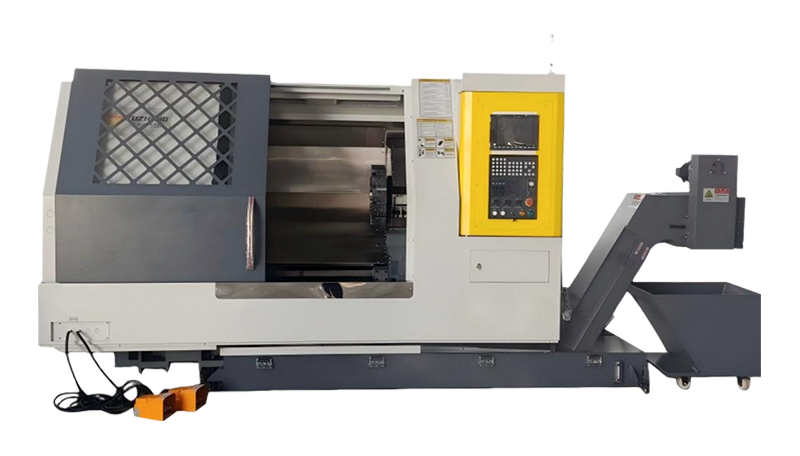 CKD Series Standard Dual-Spindle Turning and Milling MachineIdeal for shops needing a proven baseline for repeatable turning and milling jobs. Features heavy-duty mechanical spindles, rigid hardened guideways, and an integrated Y-axis for complex disk-shaped parts, delivering cost-effective high-efficiency machining.View Product →
When the workpiece geometry or production sequence is not completely standard, the CKX series allows the machine to be adapted to specific process requirements. This is often the right path for special fixtures, unusual part dimensions, or a mix of several similar parts.
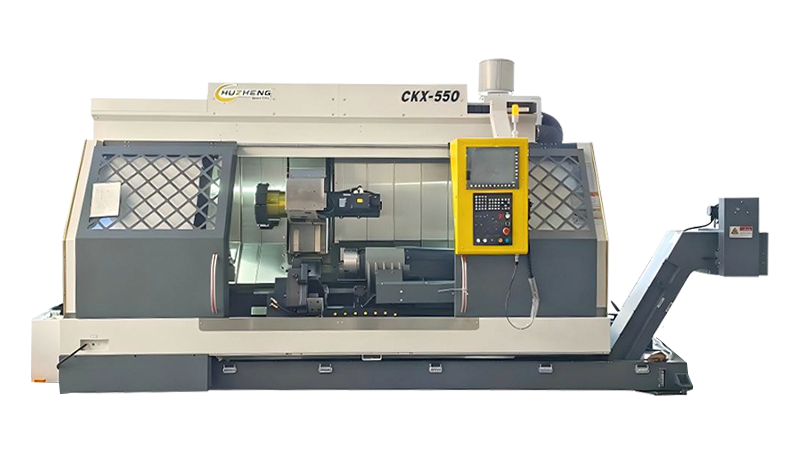 CKX Series Customizable Dual-Spindle Turning and Milling MachineDesigned for non-standard workflows, this adaptable turn-mill center handles special fixtures, unusual part sizes, or mixed similar parts. Built with high-power spindles and rigid hardened guideways, it offers flexible process customization for complex tubular workpieces.View Product →
For large and heavy workpieces, the HSL series provides a heavy-duty structure with dual-spindle capability. It is aimed at shops removing substantial material from large round parts while protecting tool life and surface quality.
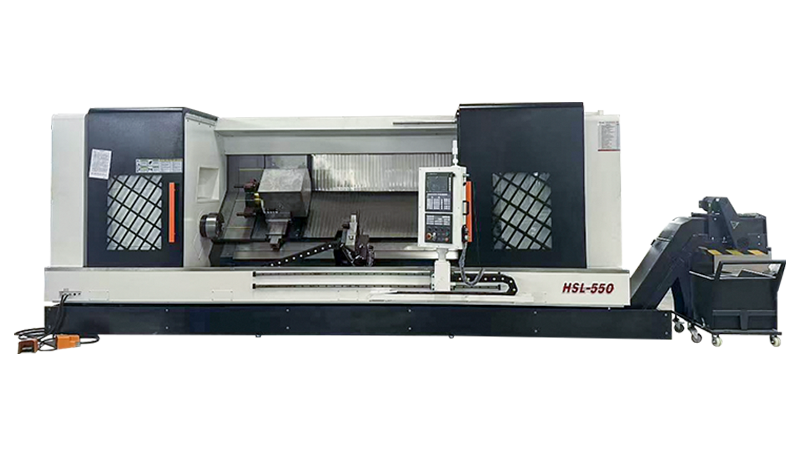 HSL Series Heavy-Duty Dual-Spindle Turning and Milling MachineFor large and heavy workpieces, this machine combines heavy-duty box guideways with dual hydraulic-driven sub-spindle thimble and programmable tailstock. Its upgraded GSK 25Ti controller ensures stable, precise material removal while protecting tool life and surface quality.View Product →
A machine tool's value depends on the precision built into its castings and guideways. At Huzheng, the manufacturing process includes CNC gantry milling, surface grinding, and guideway grinding, with quality control that starts at the casting stage and continues through assembly and after-sales service. This matters because a turn-mill machining center is only as rigid as its base and guiding elements.
Ask for documented management systems. Huzheng states compliance with ISO 9001 and ISO 14001 standards, which indicates that the company controls production quality and environmental impact. Verification of certificates during an audit is always recommended, but certified systems reduce the risk of inconsistent machine quality.
After-sales support is equally critical. Because Huzheng's spare-parts inventory and technical team are dedicated to turn-mill machines only, response times can be shorter than those of suppliers juggling many product categories. When evaluating a supplier, ask how quickly they can send a common part such as a spindle belt, hydraulic valve, or axis feedback device, and whether a process engineer is available to help with programming questions.
A CNC turn-mill machining center is not just one machine; it is a method for reducing setup time, improving location accuracy, and shortening lead time. The best path is straightforward: define the part family, choose a configuration that matches the workpiece size and complexity, verify the supplier's manufacturing and support strengths, and then compare practical tooling capability. For many shops, a dual-spindle turn-mill center with standard, customizable, or heavy-duty construction is the most productive answer.

Copyright © Xuancheng Huzheng Machinery Trading Co., Ltd. Rights Reserved.




