
 English
 中文简体
中文简体 русский
 日本語
日本語
Home / Newsroom / Industry News / CNC Milling and Turning of Cylinders: How to Choose the Right Turn-Mill Machine
Industry News
 Email: cnc88max@dingtalk.com
 Phone: +86-18021988367
Imagine a customer sends a drawing for a hydraulic cylinder barrel: 200 mm outside diameter, 150 mm bore, 450 mm long, with a 20 mm keyway on one end and six radial holes near the flange. The drawing calls for concentricity between the bore and the outside diameter within 0.015 mm. A lathe can turn the barrel, and a mill can cut the keyway and drill the radial holes. But if those operations happen on separate machines, the concentricity target depends on how accurately the part is re-clamped. That is why the decision to combine CNC turning and milling on one machine is not just about saving time; it is about controlling the error chain in a cylindrical part.
Content
CNC turning is the natural process for cylindrical surfaces. The workpiece rotates, and a stationary cutting tool removes material from the outside diameter, the bore, the end faces, and stepped profiles. Since cylinders are rotationally symmetrical, turning is the most efficient way to generate their basic form and maintain tight roundness.
CNC milling, on the other hand, addresses the features that interrupt that symmetry: keyways, flats, slots, cross-drilled holes, threaded holes, and complex contours on the end or side of the cylinder. A milling cutter or a driven tool rotates while the workpiece remains fixed or moves in controlled axes.
The practical issue is that a typical cylinder is not a pure turning part or a pure milling part. It is both. If you turn it on a lathe and then move it to a machining center, you add a setup, a datum shift, and an opportunity for error. A turn-mill machine brings both processes into one work envelope, so the bore, the outside diameter, and the milled features all share the same coordinate system. This is especially important when the reference datum is an internal bore that must be held perpendicular to the end face and aligned with a keyway.
Even with excellent machines, cylinders present specific problems that a shop has to solve before the first chip is cut. Below is a short table of the most common issues and what operators should pay attention to.
| Challenge | Typical Cause | What to Evaluate on the Machine |
|---|---|---|
| Concentricity drift between bore and OD | Re-clamping in separate machines | Dual-spindle synchronization, same-datum finishing |
| Thin-wall distortion | Cutting force and clamping point pressure | Workholding design, finishing pass strategy |
| Bore chatter or internal surface defects | Long boring bar overhang | Boring bar damping, toolholder rigidity, cutting parameters |
| Long cylinder flex during machining | Gravity and insufficient support | Tailstock support, steady rests, heavy-duty machine bed |
These problems become more visible as the length-to-diameter ratio of the cylinder increases. A part that is 600 mm long and 60 mm in diameter will flex differently than a stout 200 mm diameter barrel. The machine you choose has to match the range of your actual workpiece envelope, not just the biggest part in your catalog.
When you start comparing turn-mill machines for cylindrical workpieces, the headline specification is often spindle speed or number of axes. For cylinders, however, the more useful starting points are rigidity, workholding, and the ability to complete multiple operations without re-clamping.
In a cylinder, the bore is usually the reference feature. A dedicated cylinder-bore turn-mill machine is built to handle a sequence such as turning the outside diameter, boring the inner profile, drilling radial holes, and milling a locking slot in one setup. The benefit is not just fewer handling events; it is that the bore and the outside diameter are machined against the same datum, which reduces concentricity error caused by re-chucking.
The key machine features to verify include:
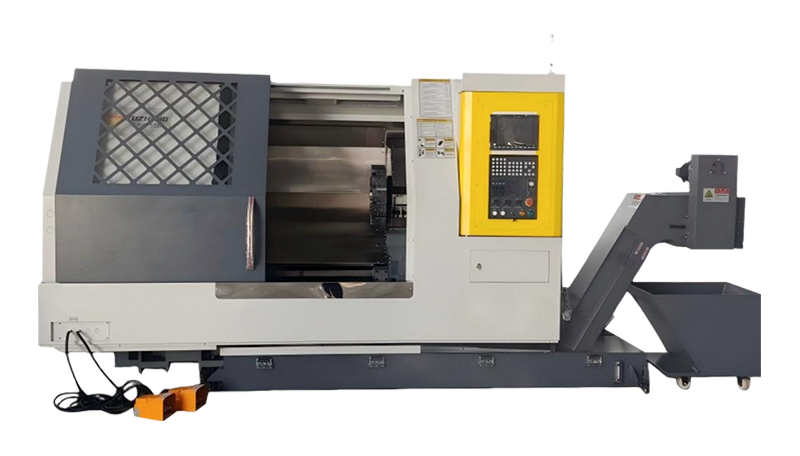 CKD Series Standard Dual-Spindle Turn-Mill for Complex Disk-Shaped PartsThe CKD series offers a cost-effective dual-spindle turn-mill solution on rigid rails, ideal for precision machining of disk-shaped workpieces with high Y-axis performance.View Product →
No single turn-mill platform covers every cylinder. A small hydraulic valve sleeve and a large power-generation cylinder have very different rigidity and workholding requirements. The correct approach is to classify your cylinder work by diameter, length, weight, and batch size, then pick a machine tier that fits.
For common hydraulic cylinders and shafts under roughly 300 mm diameter, a standard dual-spindle turn-mill machining center provides a good balance between cost and capability. It handles the typical cycle of turning, cross-drilling, face-milling, and high-speed threading without needing a separate mill.
When your drawings vary more, such as different flange patterns, tapered bores, or unusual port locations, a customizable machine becomes more attractive because you can adjust tooling, workholding, and cycle structure to the part family. A supplier that offers a configurable platform can help you standardize on a specific workholding fixture and cutting strategy, which improves cycle time consistency across different orders.
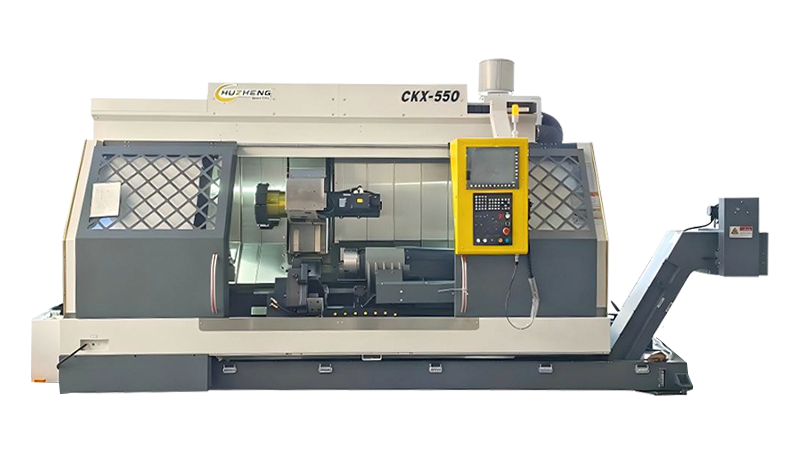 CKX Series Customizable Dual-Spindle Turn-Mill for Tubular WorkpiecesFor tubular parts with varying flange patterns and unusual port locations, the CKX is configurable, allowing tailored workholding and cutting strategies within a standard platform.View Product →
Large cylinders, thick-walled barrels, and components for oil and gas equipment introduce a different set of concerns. The machine frame has to absorb interrupted cuts, the spindle must handle large-diameter chucks without losing preload, and the tailstock needs enough force to support a long shaft without causing barreling.
In these cases, a heavy-duty dual-spindle turn-mill machine is often the right choice. It also suits cylinders that come from forging or casting with inconsistent stock conditions. The extra mass and lower center of gravity reduce vibration, which directly improves bore finish and dimensional stability.
If your manufacturing plan includes large cylinders with multi-step bores, welded-on flanges, or high surface finish requirements, be sure to ask the builder about damping, guideway width, and the maximum length-to-diameter ratio the machine can support without steady rests.
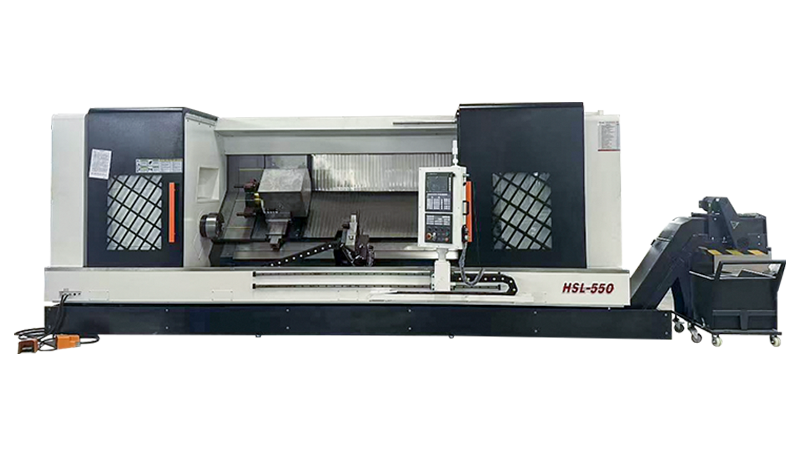 HSL Series Heavy-Duty Dual-Spindle Turn-Mill for Large CylindersThe HSL series is built for heavy-duty work on large cylinders, featuring box guideways, a programmable tailstock, and an upgraded controller to handle demanding bore finish and concentricity.View Product →
Instead of relying on brochure numbers, ask for a trial cut using your own cylinder drawing. The supplier should be able to define the expected cycle time, the surface finish on the bore, and the concentricity achievable on a representative part.
It is also worth asking how the machine handles thermal drift. Cylinder machining is rarely a one-off job; it is a production process. Over a shift, spindle heat and hydraulic oil temperature can shift the position of the tool tip. A machine with a well-designed cooling system and measured thermal compensation will be more repeatable at the end of the day.
Service response matters too. A turn-mill machine for cylinders is a capital investment, and a single downtime event can hold up an entire production line. Verify the availability of spare parts, the reachability of the service team, and the warranty conditions before signing. It is better to ask these questions while you are still comparing models than to discover a gap after the machine is installed.

Copyright © Xuancheng Huzheng Machinery Trading Co., Ltd. Rights Reserved.




