
 English
 中文简体
中文简体 русский
 日本語
日本語
Home / Newsroom / Industry News / CNC Turning and Milling Composite Center: Buyer's Guide to Done-in-One Machining
Industry News
 Email: cnc88max@dingtalk.com
 Phone: +86-18021988367
A CNC turning and milling composite center does more than add a milling head to a lathe. It is a single machine tool that carries out turning, milling, drilling, boring and tapping inside one enclosure, so a part that once travelled across three or four machines can be completed in one setup. For builders of cylinder bodies, shaft-type components, hydraulic parts and other rotationally symmetrical workpieces, that change of workflow often matters more than any single line on a specification sheet.
Xuancheng Huzheng Machinery Trading Co., Ltd. is an integrated manufacturer of dual-spindle turning and milling machines, headquartered in Xueyan, Changzhou, beside Lake Taihu. We build one family of machines and nothing else. Every engineer, every assembly station and every spare part in our stores serves turning and milling composite technology, and that narrow focus is deliberate: it shapes our process planning, our quality control and the speed of our after-sales response.
Content
The principle is easy to state and demanding to execute. A workpiece is clamped once; the main spindle turns it while a milling spindle, tool turret or B-axis head cuts on the same part. When the first end is finished, a second spindle or sub-spindle picks up the workpiece and machines the back end, so nobody has to loosen a chuck in between.
The consequences reach beyond the cycle-time chart. Fewer setups mean fewer fixtures, less handling damage, shorter queues between operations and a datum that stays exactly where it was established. Comparing the two routes side by side makes the trade-offs clear.
| Consideration | Conventional multi-machine route | Single composite center |
|---|---|---|
| Setups per part | Three to five, sometimes more | One, occasionally two |
| Workholding | Dedicated fixtures at every station | One workholding arrangement, reused |
| Datum control | Errors accumulate with each re-clamping | One datum retained across operations |
| Work in progress | Parts queue between machines | Finished parts leave the machine |
| Floor space and labour | Several machines and operators | One footprint, one operator |
| Consistency | Varies with operator and fixture condition | Repeatable and programme-driven |
None of this removes the need for process thinking. It moves the effort upstream, into programming, tool selection and workholding design, where a well-planned process multiplies the benefit of the machine itself.
Two machines can carry similar model numbers and still be entirely different tools. Four decisions shape what a composite center can do for your parts.
A single-spindle machine handles one end at a time. Opposed dual-spindle designs machine both ends within the same cycle and suit symmetrical parts and long shafts, where re-clamping is the largest single source of error. Twin-spindle layouts with independent travel add flexibility, letting two different operations run simultaneously.
Three linear axes plus a C-axis cover simple cross-drilling and light milling. Adding a Y-axis or a B-axis turns the platform into a genuine five-axis machine for angled faces, helical features and contoured surfaces. Decide this from the drawings, not from the budget.
Heavy, dense workpieces demand mass, damping and generously sized guideways; small precision parts reward speed and thermal stability instead. Machine size should follow the heaviest part family in your three-year plan rather than the average job of today.
Bar feeders, gantry loaders and robot interfaces change the economics of unattended running, and they must be planned in from the start. Confirm as well that the control supports the programming approach your team already uses. Our CNC turning and milling composite solution overview explains how these elements come together on one platform.
Machine selection becomes straightforward once workpieces are grouped by the features they share rather than by the industry they serve.
Engine blocks, hydraulic cylinders, pneumatic barrels and similar parts combine a long internal bore with end-face and cross features. A composite center turns the bore, mills the faces and drills the ports without moving the workpiece, which protects concentricity and reduces fixture wear.
Shafts, spindles and stepped axles need both ends machined, often with keyways, flats and cross-holes. Dual-spindle machines finish these parts in a single cycle, and the reduced handling is especially valuable for slender parts that distort when clamped twice.
Valve bodies, pump housings and cylinder heads reward a machine that can switch between turning and milling inside one programme. Interrupted cuts and tight bore tolerances make structural rigidity a primary requirement rather than a luxury.
Large flanges, tubes, rolls and housings need travel, load capacity and stiffness more than high spindle speeds. Confirm the maximum swing, the weight the spindle can carry and how the structure behaves under heavy interrupted cutting.
Because we build only composite machines, our catalogue stays short enough to know by heart. Three series cover the great majority of the work our customers bring to us.
The CKD series is our standard dual-spindle turning and milling machine. It is the natural starting point when part families are stable, the process is well understood and the priority is a proven configuration delivered without a long engineering cycle.
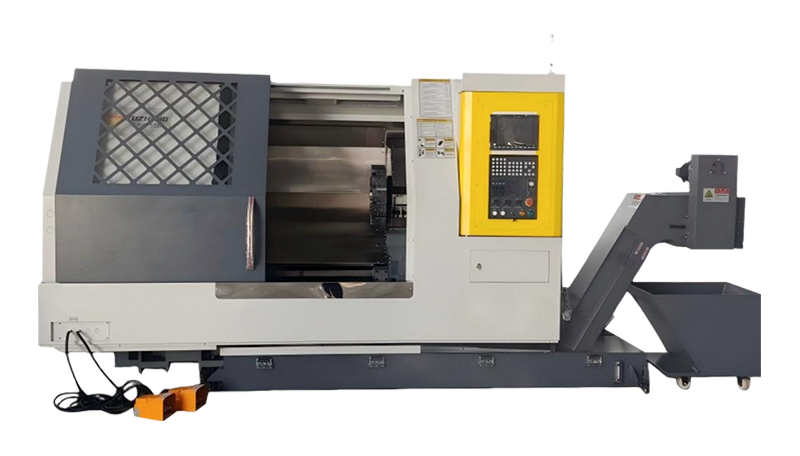 CKD Series-Standard Model Dual-Spindle Turning and Milling MachineCKD Dual-Spindle Turn-Milling Center Derived from the mature R D technology and manufacturing capabilities of slant-bed turning machines, the CKD550-750CYS and CKD750-...View Product →
The CKX series is the customizable dual-spindle machine. When a part demands an unusual tool arrangement, a special chuck, extra travel or a tailored automation interface, this is the platform where our engineers redesign rather than compromise.
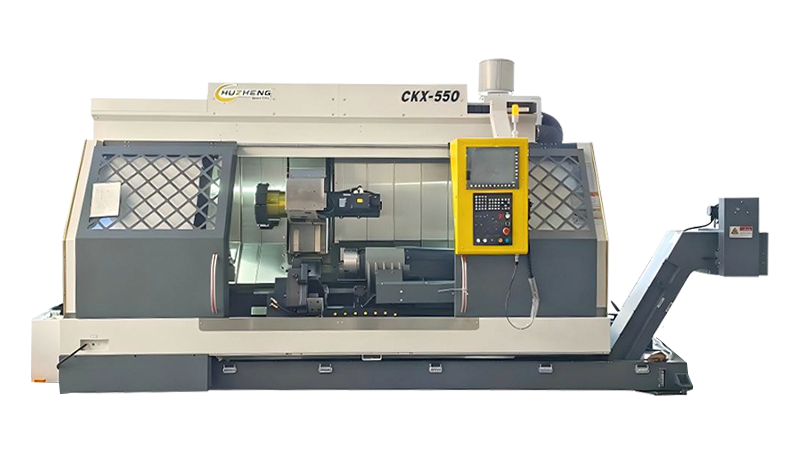 CKX Series -Customizable Dual-Spindle Turning and Milling MachineCKX Dual-Spindle Turn-Mill Machining CenterView Product →
The HSL series is the heavy-duty option, built for large, dense workpieces where cutting forces are high and structural stiffness decides whether a process is stable. Castings, guideways and drive sizing are all scaled to that load.
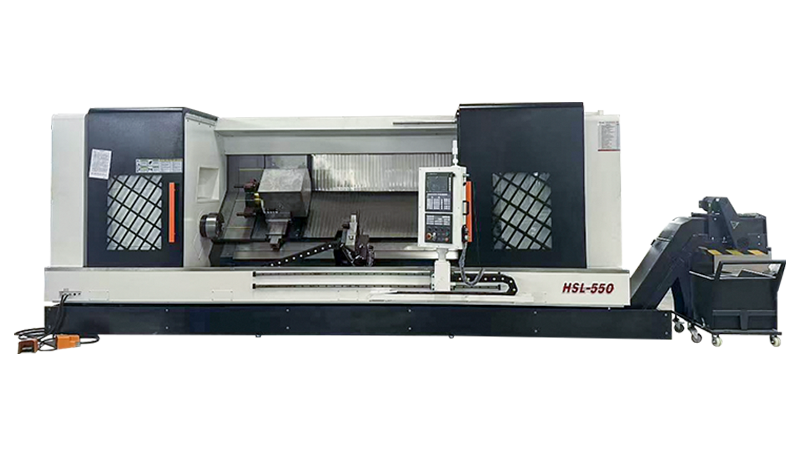 HSL Series - Heavy-Duty Dual-Spindle Turning and Milling MachineThe HSL Dual-Spindle Turn-Mill Machining Center is built on the mature R D technology and manufacturing capabilities of slant-bed lathes. It features two models, HSL55...View Product →
Specification sheets rarely settle the question of how a machine will behave in your shop. These points are worth verifying during evaluation:
A composite center is only as productive as the ramp-up behind it. Our service model keeps spare parts and technical support dedicated to turning and milling machines alone, which shortens the distance between a problem and a fix. A typical introduction follows a consistent sequence:
Because the same team that builds the machine also supports it, feedback from the shop floor returns to our design and assembly process instead of disappearing into a service report.
The direction of travel across the machine tool sector is clear: fewer operations, more intelligence, less waste. Manufacturers are pushing towards integrated processes that complete complex parts in one setup and towards controls and automation that make unattended shifts realistic rather than theoretical. Environmental pressure is having a similar effect, because fewer setups mean less energy, less coolant and less scrap per finished part. Our reading of these trends, and the reasons efficient turn-mill composite machines are gaining ground so quickly, is set out in this industry analysis of efficient turn-mill machining.
A CNC turning and milling composite center is a long-term process investment, and the machine is only half of what you buy. Process planning support, responsive spare-part supply and a builder who stays focused on a single technology matter just as much as spindle torque or rapid traverse. If your part family includes cylinder bores, shafts, hydraulic components or heavy rotationally symmetrical workpieces, send us your drawings and cycle requirements. We will tell you honestly which configuration fits, and how quickly it can be running on your floor.

Copyright © Xuancheng Huzheng Machinery Trading Co., Ltd. Rights Reserved.




