 English
 中文简体
中文简体 русский
 日本語
日本語
Home / Newsroom / Industry News / How Efficient Machining Turn-Mill Composite Machine Tools Are Changing Modern Manufacturing
Industry News
 Email: cnc88max@dingtalk.com
 Phone: +86-18021988367
Content
A turn-mill composite machine tool — also referred to as a mill-turn center or multi-tasking CNC machine — is a machine that integrates the capabilities of a CNC lathe and a machining center into a single platform. Instead of moving a workpiece from a turning machine to a milling machine and then to a drilling station, a turn-mill composite machine performs all of those operations in one setup, often with the part never leaving the spindle until it is fully finished.
The drive toward efficient machining turn-mill composite machine tools comes from a straightforward industrial reality: every time a part is re-fixtured or transferred between machines, you introduce the risk of positional error, add setup time, and lose spindle utilization. A composite turn-mill center eliminates those gaps. The result is dramatically shorter cycle times, fewer operator interventions, and tolerances that are far easier to hold because the part's datum never shifts between operations.
These machines have evolved significantly over the past two decades, from basic CNC lathes with driven tool turrets into fully integrated multi-axis platforms capable of simultaneous 5-axis milling, deep-hole drilling, gear cutting, and even grinding — all within a single work envelope. For manufacturers producing complex aerospace components, hydraulic valve bodies, medical implants, or automotive powertrain parts, the turn-mill composite machine tool has become the efficiency benchmark.
Not all turn-mill composite machines are built the same way. The configuration you choose determines what parts you can produce and how efficiently you can produce them. The major configurations include:
This is the entry-level turn-mill configuration. A standard CNC turning center is equipped with a live tooling turret that can power rotating tools — mills, drills, taps — while the main spindle is indexed to a fixed C-axis position. Adding a Y-axis to the turret allows off-center milling, cross-hole drilling, and keyway cutting. These machines are cost-effective and handle a wide range of shaft and chuck parts with moderate geometric complexity. Their limitation is that milling capability is restricted to the tools that fit within the turret — there is no full milling head or automatic tool changer for the rotating tools.
A step up from the driven-turret configuration, these machines feature a dedicated high-speed milling spindle mounted on a B-axis (tilting head) in addition to the main turning spindle. This enables true 5-axis simultaneous machining — the milling spindle can approach the workpiece from any angle while the main spindle rotates or indexes on the C-axis. This configuration is the workhorse for complex aerospace and medical parts. Tool magazine capacities typically range from 40 to 120+ positions, giving access to a full complement of turning inserts and milling tools without manual changes.
For high-volume production, twin-spindle configurations add a sub-spindle opposite the main spindle. The sub-spindle picks up a partially machined part from the main spindle and completes the backside operations simultaneously — meaning both ends of a part are finished in one cycle without operator intervention. Paired with twin turrets (upper and lower), these machines can run four tools simultaneously, cutting cycle times in half compared to single-turret setups. This is the preferred configuration for bar-fed production of complex turned parts in automotive and hydraulics industries.
For large, heavy prismatic components that also require turning, horizontal turn-mill centers mount the workpiece on a large rotary table (B-axis) that serves as both the turning spindle and the positioning axis for milling. These machines handle components like large valve bodies, pump housings, and flanged shafts that would be impractical on a standard turning center. Integrated pallet changers allow one part to be machined while the next is set up, keeping spindle utilization above 80%.
The efficiency advantages of turn-mill composite machining are measurable and well-documented. Here is a direct comparison between a conventional multi-machine process and a turn-mill composite approach for a representative complex part:
| Process Factor | Conventional Multi-Machine | Turn-Mill Composite Center |
| Number of Setups | 3–5 separate setups | 1–2 setups |
| Inter-Machine Transfer Time | 30–120 min per batch | Eliminated |
| Fixturing Cost | High (per machine) | Low (single fixture) |
| Positional Accuracy Risk | Cumulative re-fixture error | Single datum reference |
| WIP (Work In Progress) | High (queues between machines) | Minimal |
| Floor Space Required | Large (multiple machines) | Compact (one machine) |
| Operator Headcount | 1 per machine | 1 for entire process |
In practice, manufacturers switching from conventional multi-machine workflows to turn-mill composite machining regularly report total throughput time reductions of 40–70% for complex parts, with corresponding reductions in labor cost per part. The elimination of work-in-progress queuing alone can cut lead time from weeks to days for job shop environments.
The efficiency of a modern turn-mill composite machining center comes from the integration of several advanced technologies working together — not just from combining two machine types in a single frame.
The most capable turn-mill centers support simultaneous 5-axis motion — meaning the X, Y, Z linear axes and the B (tilt) and C (rotation) axes move at the same time during a cut. This allows a milling tool to maintain a constant contact angle on complex curved surfaces, such as turbine blade root features or orthopedic implant geometries, without the tool retract-and-reposition moves required by 3-axis machining. The result is better surface finish, shorter cycle time, and access to features that simply cannot be reached with 3-axis approaches.
The main turning spindle on a turn-mill center must serve a dual role: it needs the torque and rigidity of a lathe spindle for heavy roughing cuts, while also providing the angular precision of a rotary positioning axis (C-axis) for milling operations. Modern turn-mill spindles use built-in torque motor technology to achieve C-axis positioning accuracies of ±0.001° or better, while delivering peak torques of 500–2,000 Nm for aggressive turning of hardened steels and superalloys.
A turn-mill composite machine generates heat from multiple sources simultaneously — the turning spindle, the milling spindle, the drives, and the coolant system. Without active thermal management, this heat causes structural distortion that shifts the tool path away from the programmed position. High-end turn-mill centers use networks of thermal sensors combined with compensation algorithms in the CNC controller to continuously correct for thermal drift, maintaining positioning accuracy within 2–5 microns even after extended production runs.
Turn-mill composite machining for tight-tolerance parts benefits enormously from on-machine probing. Touch-trigger probes mounted in the tool magazine can measure a critical diameter or position after turning, feed the result back to the CNC, and automatically adjust the finishing pass offset — all without stopping the cycle or calling in an operator. Some advanced systems incorporate laser tool measurement to detect broken tools and update tool length offsets automatically, enabling truly lights-out machining for complex parts.
Programming a turn-mill composite machine efficiently requires CAM software that understands the machine's full kinematic model — which axis handles which operation, how turret indexing interacts with spindle rotation, and how to synchronize the main and sub-spindles for part handoff. Platforms such as Siemens NX CAM, Mastercam Mill-Turn, and ESPRIT are specifically engineered for turn-mill programming, allowing engineers to simulate the entire process — including collisions, axis limits, and cycle time — before a single chip is cut.
While any manufacturer producing complex rotational parts can benefit from a turn-mill composite machine tool, certain industries and part families see the most dramatic efficiency gains:
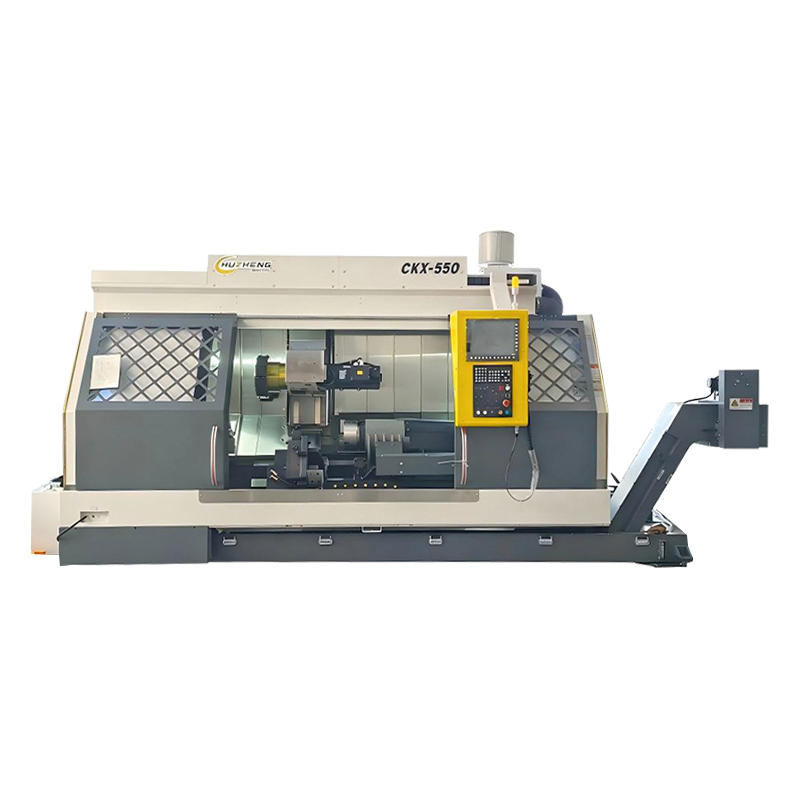
Owning a turn-mill composite machine does not automatically guarantee efficient machining. The machine's potential is only realized through deliberate process engineering. Here are the strategies that consistently deliver the best results:
On twin-spindle or twin-turret machines, the total cycle time is determined by the longest individual operation — the bottleneck axis. If the upper turret finishes its roughing in 4 minutes but the lower turret needs 7 minutes to complete its operations, the machine sits idle on the upper side for 3 minutes every cycle. Process engineers should analyze the initial cycle time breakdown and redistribute cutting operations between turrets to equalize the load and minimize the bottleneck time. Even modest rebalancing can improve overall cycle efficiency by 20–30%.
Many turn-mill composite CNC controllers support synchronized operation — where the main spindle and sub-spindle run a part between them while both turrets are cutting simultaneously. This "4-corner machining" approach can dramatically reduce cycle time. For example, while the main spindle turns the OD, the sub-spindle can simultaneously drill the backside center or mill a rear face feature. Planning these synchronized cuts during the programming phase, rather than running operations sequentially, is one of the highest-impact efficiency levers available.
Turn-mill milling operations often take place in a more constrained environment than a conventional machining center — tool reach is limited by the chuck jaws and the turret body, and vibration from the rotating spindle affects surface finish. High-feed milling strategies (shallow axial depth, large radial engagement) work well in these conditions because they minimize radial cutting force. Trochoidal milling paths for pocket features keep tool engagement consistent and reduce heat buildup in difficult materials. Matching the tool path strategy to the turn-mill's specific rigidity characteristics is essential for both efficiency and tool life.
The full efficiency advantage of a turn-mill composite machine is realized when it runs unattended. Bar feeders for shaft and smaller chuck work, combined with a gantry robot or collaborative robot for larger blanks, allow the machine to run through multiple shifts without a dedicated operator. A single operator can then oversee two or three turn-mill cells, inspect parts, and manage tool changes — transforming the labor model compared to conventional multi-machine production. Programming the machine's automatic tool life management system to offset or swap tools at defined cut-length thresholds is what enables this automated operation to maintain quality without inspection after every part.
On a turn-mill composite machine, the driven tool turret and milling spindle interface must handle both the static clamping forces of turning inserts and the dynamic bending loads of rotating milling tools. Tooling systems like Capto, HSK-T, and VDI with precision bore play a critical role in maintaining the repeatability needed for tight-tolerance features. Using short, rigid tool assemblies, minimizing tool overhang, and selecting insert geometries matched to the depth-of-cut and material will directly impact both surface finish and cycle efficiency.
Despite their advantages, turn-mill composite machine tools come with real challenges that manufacturers need to plan for before making the investment:
The turn-mill composite machine tool market is served by a range of builders, from broad-line CNC manufacturers to specialists focused exclusively on multi-tasking platforms. Understanding their key differentiators helps manufacturers make the right selection for their specific production requirements.
| Builder | Known For | Target Application |
| Mazak (Integrex Series) | Full 5-axis turn-mill, DONE IN ONE philosophy, Smooth CNC control | Aerospace, energy, general precision |
| DMG Mori (CTX / NTX Series) | High-precision B-axis milling spindle, Siemens or CELOS control | Medical, automotive, toolmaking |
| Okuma (Multus Series) | Thermo-Friendly concept for thermal stability, OSP control | General machining, heavy industry |
| Nakamura-Tome | Twin-spindle twin-turret specialist, compact high-productivity cells | Automotive, hydraulics, bar work |
| Index / Traub | Gang slide and multi-spindle turn-mill for high-volume production | High-volume precision components |
| Doosan (Puma MX / Lynx Series) | Value-competitive turn-mill with strong milling spindle performance | Job shops, general subcontract |
When evaluating machine builders, manufacturers should look beyond the base specifications and assess the builder's applications engineering support, post-sale training capability, and parts availability in their region. A turn-mill composite machine that exceeds its programmed potential through good applications support consistently outperforms a technically superior machine where the user is left to figure things out independently.
The evolution of turn-mill composite machine tools is accelerating, driven by demand for greater automation, tighter tolerances, and integration with digital manufacturing environments. Several clear trends are shaping the next generation of these machines.
Additive-subtractive hybrid machines are expanding the turn-mill concept further. Machines like the DMG Mori Lasertec series combine directed energy deposition (DED) additive manufacturing with full 5-axis turn-mill capabilities. A part can be built up in near-net shape by additive deposition and then finish-machined to final dimension — all in a single machine cycle. This is particularly relevant for large, expensive titanium aerospace structures where reducing the buy-to-fly ratio has enormous economic impact.
Digital twin integration is becoming standard on premium turn-mill centers. Before a single part is cut, a complete virtual simulation of the machining process — including all axis movements, tool paths, chip loads, and potential collision events — runs in real time on a digital model of the machine. This virtual commissioning approach eliminates prove-out scrap, reduces new part programming time, and allows remote process optimization without interrupting production.
AI-driven adaptive machining is beginning to appear in production-ready form. Sensors embedded in the spindle and turret measure cutting force, vibration, and acoustic emission in real time. Machine learning algorithms process this data to detect tool wear, adjust feed rates dynamically to protect surface finish, and predict the optimal tool change point before a tool fails. For turn-mill composite machines running complex, high-value parts, this adaptive capability is transforming the economics of unattended machining by making it genuinely reliable rather than aspirational.
For manufacturers committed to staying competitive in precision component production, the efficient machining turn-mill composite machine tool is not simply an equipment upgrade — it is a fundamental rethinking of how complex parts are made. The shops that learn to unlock the full capability of these machines, from synchronized multi-spindle cutting to AI-assisted process control, will be the ones setting the pace in precision manufacturing through the next decade.

Copyright © Xuancheng Huzheng Machinery Trading Co., Ltd. Rights Reserved.