 English
 中文简体
中文简体 русский
 日本語
日本語
Home / Newsroom / Industry News / Hydraulic Turning and Milling Composite Center: What It Is and Why More Machine Shops Are Switching
Industry News
 Email: cnc88max@dingtalk.com
 Phone: +86-18021988367
Content
A Hydraulic Turning and Milling Composite Center is a machine tool that combines turning (lathe-style rotation) and milling (rotary cutting) into a single work envelope, using a hydraulic power system to drive clamping, tailstock movement, tool changes, and sometimes spindle braking. Instead of moving a workpiece between a separate lathe and a separate mill, the part stays fixed in one setup while the machine switches between turning and milling operations automatically. This is why the machine is often called a "composite" or "turn-mill" center — it merges two traditionally separate processes into one continuous workflow.
The hydraulic component is what sets this type of composite center apart from purely electro-mechanical or pneumatic designs. Hydraulic systems generate very high clamping force and smooth, controllable motion, which is critical when a part needs to be held rigidly while a milling cutter is applying side loads to it — something that pure turning setups were never originally designed to withstand.
In a hydraulic turning and milling composite center, oil pressure — not just electric servo force — is used to control several critical functions. This gives the machine both strength and smoothness that would be difficult to achieve with mechanical linkages alone.
The hydraulic chuck applies consistent, adjustable clamping force to the workpiece. Operators can fine-tune pressure based on material hardness and wall thickness, which matters a lot when machining thin-walled parts that could deform under excessive force.
Long or slender shafts often need a tailstock or steady rest to prevent vibration during milling. Hydraulic actuation lets these supports apply steady, even pressure that can be adjusted mid-cycle, reducing chatter and improving surface finish.
Hydraulic actuators are also commonly used to lock the spindle in place during milling operations and to power automatic tool changers, ensuring quick, repeatable tool swaps between turning and milling tasks without manual intervention.
Shops that switch to a hydraulic turning and milling composite center typically do so because it solves several long-standing production headaches at once. Below is a side-by-side comparison of traditional two-machine workflows versus a composite center approach.
| Factor | Separate Lathe + Mill | Hydraulic Turning and Milling Composite Center |
| Setups Required | Two or more | One |
| Part Accuracy | Affected by re-clamping errors | Higher, since part never moves |
| Floor Space Needed | Two machine footprints | One machine footprint |
| Cycle Time | Longer, due to transfer time | Shorter, continuous processing |
| Labor Involvement | Higher, manual transfer needed | Lower, mostly automated |
Beyond the table above, the biggest hidden benefit is consistency. When a part is turned and milled in one clamping, there's no accumulated positional error from moving it between machines — this alone can be the difference between a part passing tight tolerance inspection or getting scrapped.
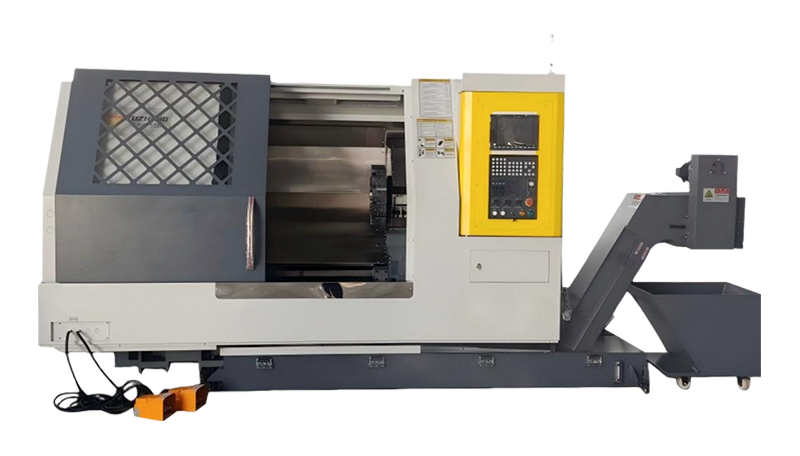
Before buying or operating a hydraulic turning and milling composite center, it helps to understand the major components that make the machine function as a single, coordinated system.
Hydraulic turning and milling composite centers are especially valuable in industries where parts are complex, tolerances are tight, and production volume doesn't justify dedicated tooling for every operation.
Aerospace parts like shafts, housings, and structural fittings often require both cylindrical turning and complex pocket or hole milling. A composite center reduces the number of fixtures needed and improves geometric accuracy across features.
Valve bodies, flanges, and connectors used in oil and gas applications typically have both round profiles and flat milled faces or drilled ports, making them well suited to single-setup turn-mill processing.
Surgical instruments and implant components demand extremely tight tolerances and smooth finishes, both of which benefit from eliminating repositioning error between turning and milling steps.
Not every shop needs the same configuration. Choosing the right machine depends on part size, material, and production goals. Consider the following factors before making a purchase decision.
Because the hydraulic system is central to how a turning and milling composite center operates, proper maintenance directly affects both uptime and part quality. Neglecting hydraulic fluid condition or seal wear can lead to inconsistent clamping force, which shows up as chatter marks, dimensional drift, or even part slippage during milling.
Set a routine schedule to check hydraulic fluid levels, inspect for leaks around cylinders and hoses, and replace filters at manufacturer-recommended intervals. It's also worth monitoring hydraulic pressure gauges during operation, since a slow pressure drop often signals a developing seal or pump issue before it causes a production problem.
Keeping a maintenance log specifically for the hydraulic subsystem, separate from general machine maintenance, makes it much easier to spot patterns and catch problems early — which ultimately protects both your parts and your production schedule.

Copyright © Xuancheng Huzheng Machinery Trading Co., Ltd. Rights Reserved.