
 English
 中文简体
中文简体 русский
 日本語
日本語
Home / Newsroom / Industry News / CNC Milling vs Turning: How Turn-Mill Centers Solve Real Shop Challenges
Industry News
 Email: cnc88max@dingtalk.com
 Phone: +86-18021988367
When a part needs both a smooth outside diameter and a milled pocket, the shop floor often becomes the battleground between two technologies. CNC turning rotates the workpiece to create cylindrical features. CNC milling spins the tool to produce flats, slots, and contours. Neither is inherently better, but moving a semifinished part between machines can erase the gains you made in cutting speed. For many shops, the real conversation is not milling versus turning. It is how to finish both sets of features in one setup.
Content
CNC turning is a subtractive process where the workpiece rotates and a fixed cutting tool removes material. The operation is efficient when the part is round or cylindrical. Bar stock, castings, and forgings are mostly turned to achieve tight concentricity and a good surface finish.
CNC milling works in the opposite way. The workpiece is clamped onto a table, and the cutting tool rotates. As the tool moves along X, Y, or Z axes, it cuts material from a stationary or slowly moving component. This approach allows a machine to produce shapes that turning cannot reach.
A single decision becomes harder when the part has both round and flat features. A standard shaft might need a turned diameter and a milled keyway. A housing might need a bored hole and a machined face. In such cases, using only one process forces you to add an extra machine, an extra fixture, and an extra inspection point.
The table below summarizes the typical strengths of each approach in a small job shop.
| Process | Typical part shape | Primary movement | Best for |
|---|---|---|---|
| CNC turning | Round or cylindrical | Workpiece rotates, tool is stationary | ODs, threads, bores, facing |
| CNC milling | Flat, prismatic, or sculpted | Tool rotates, workpiece is clamped | Slots, pockets, complex profiles |
| Turn-mill machining | Complex, multifeature parts | Both tool and workpiece can rotate | Parts needing OD turning plus milling in one fixture |
In practice, a turn-mill center offers the greatest flexibility when a single part contains both rotational and prismatic features. The machine can turn the outside, stop the spindle, and mill a keyway without repositioning the part. This is why the comparison is not just between two processes, but between two production routes.
Consider a shaft with a machined outside diameter, a drilled cross hole, and a milled flat face. On separate turning and milling machines, the workpiece is clamped, turned, unclamped, inspected, moved, reclamped, aligned, and milled. Each setup introduces the possibility of concentricity error, tool offset drift, and handling damage.
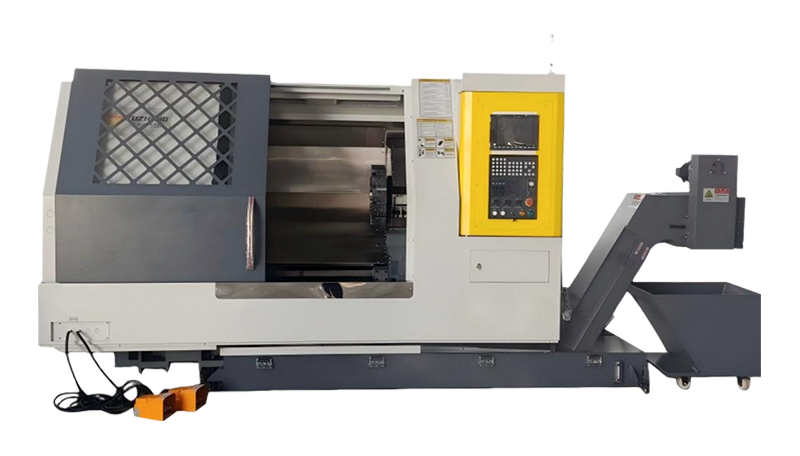 CKD Series Dual-Spindle Turn-Mill Center for Disc PartsThis standard dual-spindle machine reduces multiple setups for complex disc-shaped workpieces, improving concentricity and cutting efficiency while offering high rigidity and cost-effectiveness.View Product →
For a shop running 500 units per month, the difference between two setups and one setup is not just five or ten minutes. It is the accumulated effect of alignment time, tool offset checks, and handling. A part that took 25 minutes per piece in two machines may take 16 minutes in a turn-mill center. That alone changes the cost per part before you count the reduced scrap rate.
Shops that adopt an efficient machining turn-mill composite machine tool can often reduce the number of fixture setups on a typical shaft. The outside diameter is turned, then the spindle indexes and the milling operation begins. The part does not move. The tolerance between the turned diameter and the milled flat is now determined by the machine geometry, not by the skill of the setup operator.
A standard dual-spindle center is a strong starting point for many shops. However, you may need to adapt the machine to your existing workholding, tooling, or part dimensions. The CKX series is designed for shops that need a tooling layout that matches their existing pallets, rotary tables, or clamping systems.
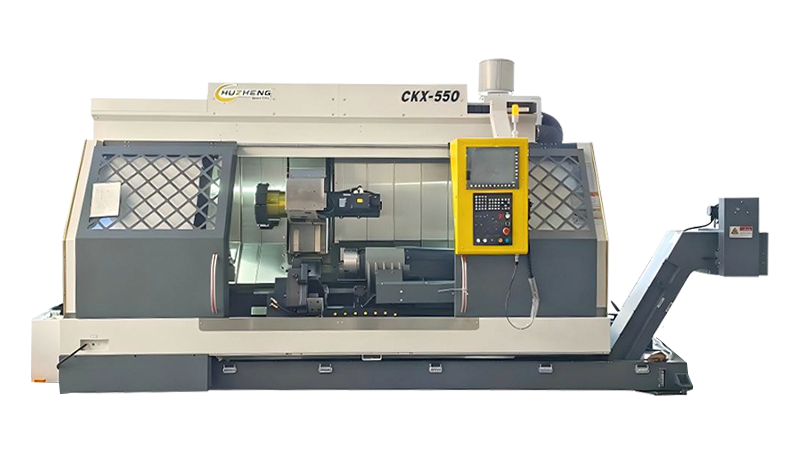 CKX Series Customizable Dual-Spindle Turn-Mill MachineDesigned for shops needing adaptation to existing workholding and tooling, this customizable center minimizes switching time and human intervention for families of parts with minor changes.View Product →
For example, a hydraulic valve body may have a unique casting or a proprietary blank that is not compatible with standard jaws. Customizing the machine around those workpieces reduces human intervention and switching time. This is especially important when the production run repeats a family of parts with minor changes.
When the workpiece needs both ends machined or requires a five-axis contour, the equipment choice changes. A dual-spindle center allows one end to be machined while the other end is brought into the work zone. A five-axis milling and turning machine can manipulate the part orientation to reach undercuts and angled features that a three-axis setup cannot.
This is not always the right investment. If the majority of your parts can be machined in a single workflow with two axes, a dual-spindle center is more cost-effective. If the complexity is consistent across your product line, the broader axis range is worth examining.
When the part is heavy, long, or creates large vibration forces during interrupted cuts, a heavy-duty center can make the difference between stable and marginal results. The HSL series is positioned for such parts. It provides the structure required to keep a large workpiece stable during both turning and milling.
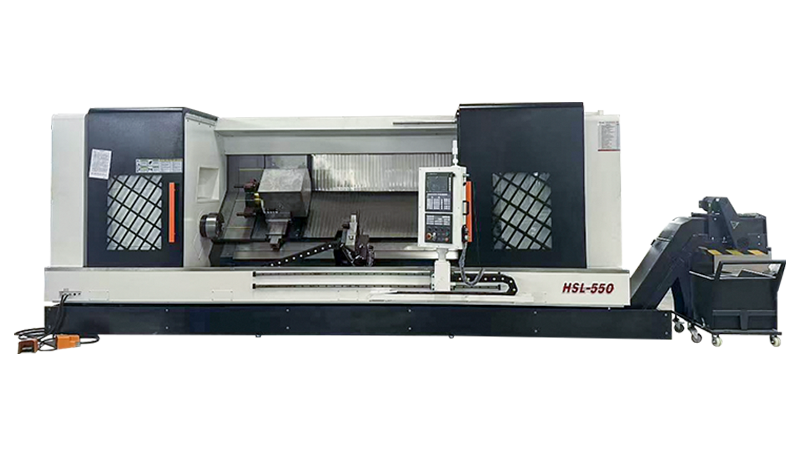 HSL Series Heavy-Duty Dual-Spindle Turn-Mill MachineEngineered for large shafts and heavy flanges, this heavy-duty center provides stability during interrupted cuts, ensuring repeatability and replacing two separate machines with one.View Product →
This type of machine is commonly applied to large shafts, heavy flanges, and cylinder components where a standard machining center would struggle to hold tolerance over a long unsupported span. The value shows up in repeatability, especially on parts that previously required two separate machines and two separate operators.
Before purchasing any new equipment, I recommend building a simple baseline.
In most cases, the first benefit appears in throughput. The second appears in quality, because the part stays on one reference plane from roughing to finishing. The machine you choose should be evaluated by its ability to hold that reference plane over the full length, diameter, and batch size you actually run.
For a shop that runs parts with both round and prismatic features, choosing between CNC milling and CNC turning often results in a split process. But the split is not necessary. A turn-mill center can do both jobs in one fixture, which is the most direct way to protect your tolerances and your delivery date.

Copyright © Xuancheng Huzheng Machinery Trading Co., Ltd. Rights Reserved.




