
 English
 中文简体
中文简体 русский
 日本語
日本語
Home / Newsroom / Industry News / CNC Turning and Milling Composite Solution: A Practical Buyer's Guide for Shops
Industry News
 Email: cnc88max@dingtalk.com
 Phone: +86-18021988367
Walk through almost any machining shop and the first bottleneck you notice is rarely spindle speed. It is the movement of parts between machines. A workpiece turns on a lathe, then moves to a mill, then to a drill, and every one of those moves costs a setup, a re-clamping, and one more chance for the geometry to drift.
A CNC turning and milling composite solution exists to remove that movement. Turning, milling, drilling, and tapping happen on a single machine platform, held in a single workholding position, finished in a single cycle.
Having spent years focused on exactly this category of machine, we have watched shops move composite machining from a curiosity to a workhorse. What follows is what we consider worth knowing: why single-setup machining pays off, how machine architecture decides what you can actually produce, and which questions separate a real solution from a specification sheet.
Content
At its core, a turning and milling composite solution combines a CNC lathe and a machining center on one bed. A turning spindle handles the rotary work. Driven tools mounted on a turret, or a separate milling spindle, take care of the prismatic features such as flats, keyways, radial holes, and helical slots. A subspindle picks up the part for back-end work, so the second operation disappears.
The real value is structural rather than feature-based. When milling and turning share the same spindle axis, bores and faces reference one another directly. Every setup you remove from the dimensional chain is one less opportunity for stack-up error, which matters most to shops held to tight concentricity and position tolerances.
If you would rather see the overview before diving into specifications, our CNC turning and milling composite solution page lays out the full machine family behind this approach.
Cycle time is what people notice first. The deeper gains show up over months of production.
For parts with complex geometry and tight tolerances, those gains tend to pay back the investment within a fairly short production window. For simple parts with loose tolerances, they often do not, and it is worth being honest about that before committing capital.
The phrase turning and milling composite covers a wide range of machine layouts, and the differences are not cosmetic. Spindle count, turret count, and whether the milling axis travels in Y or B all determine how gracefully a machine handles your particular part family.
| Configuration | How the part is held | Typical best fit |
|---|---|---|
| Single spindle with driven turret | One clamping, face and outside features | Symmetric parts, simple housings needing milled flats |
| Dual spindle with subspindle | One clamping covering both ends | Shafts, fittings with features at each end, tubular parts |
| Five-axis mill-turn | Multi-directional simultaneous work | Complex geometry with angled holes and contoured surfaces |
| Double-head turning and milling | Both ends machined at once | Long shafts, symmetrical parts, higher volume runs |
In our experience, configuration choices matter more than brand choices. A machine matched to the part turns a stalled process into a smooth one. A machine that is one axis short or one spindle light simply relocates the problem somewhere else in the workflow.
Once you know the part envelope, the features on both ends, and the takt time you need to hit, the series decision usually makes itself. Our own range is built along that logic, with each series aimed at a different combination of load and customization rather than one machine stretched across every job.
The CKD series is the standard model. Dual spindle, proven configuration, and a good fit for shops that need both ends of a part finished in one setup without funding custom engineering. When the part family is stable, it is usually the most economical place to start.
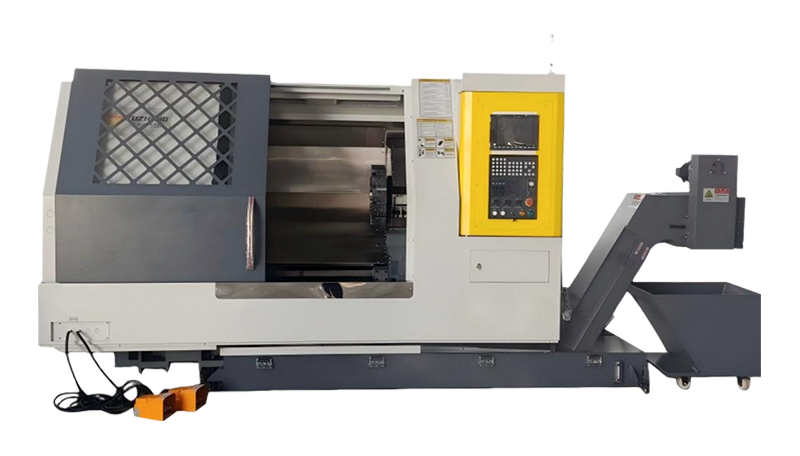 CKD Series-Standard Model Dual-Spindle Turning and Milling MachineCKD Dual-Spindle Turn-Milling Center Derived from the mature R D technology and manufacturing capabilities of slant-bed turning machines, the CKD550-750CYS and CKD750-...View Product →
The CKX series sits at the customizable end. When a part calls for a specific turret arrangement, a longer travel, or an additional axis to meet takt time, this is the right baseline. Customization does not have to be dramatic. Sometimes a modest change in stroke or tool position is all that stands between a cycle that misses the target and one that comfortably beats it.
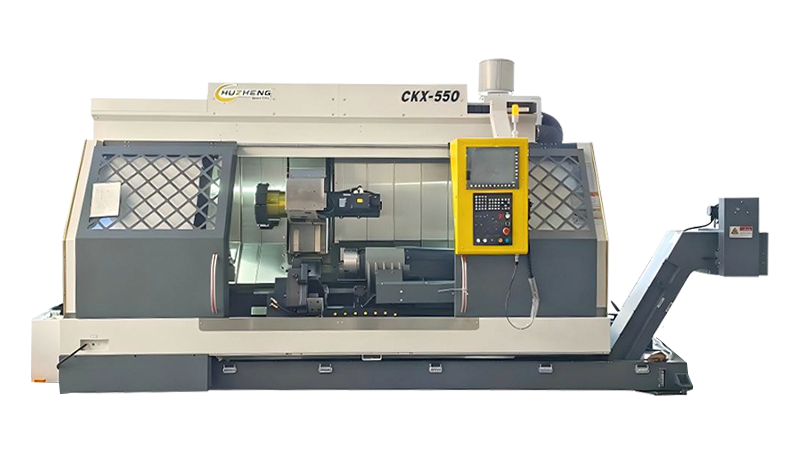 CKX Series -Customizable Dual-Spindle Turning and Milling MachineCKX Dual-Spindle Turn-Mill Machining CenterView Product →
The HSL series is built for heavy-duty work. Large shafts, thick-walled cylinders, and castings that demand genuine rigidity belong here. Heavy cutting rewards mass and stiffness, and a lighter machine cannot compensate for that no matter how favorable the numbers look on paper.
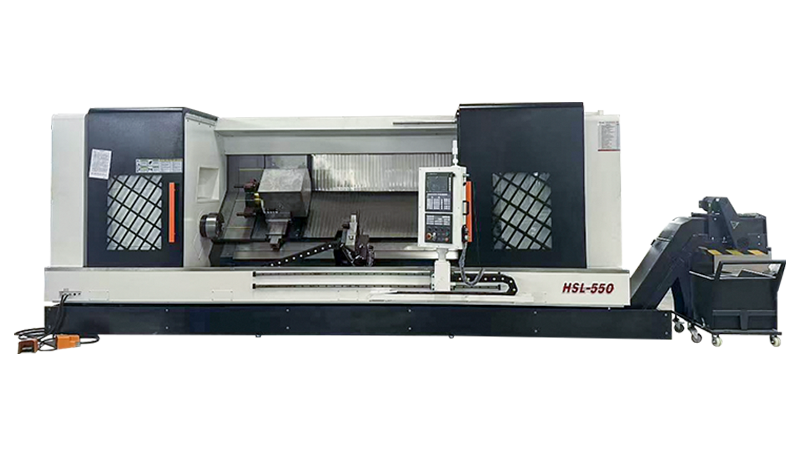 HSL Series - Heavy-Duty Dual-Spindle Turning and Milling MachineThe HSL Dual-Spindle Turn-Mill Machining Center is built on the mature R D technology and manufacturing capabilities of slant-bed lathes. It features two models, HSL55...View Product →
Not being sure which series fits is usually a sign that the process itself has not been fully worked out yet. That is a normal stage, and it is usually resolved faster by sharing a drawing than by comparing catalogs.
Not every part belongs on a turn-mill machine. Some jobs run more profitably on dedicated equipment, and forcing them onto a composite platform adds complexity without reducing cost. The pattern that consistently favors composite machining involves parts with features on multiple faces and tolerances that tighten when setups multiply.
Engine blocks, hydraulic cylinders, and pneumatic barrels combine a large amount of rotary work with strict relationships between bores and outer surfaces. Combining those operations on one machine keeps a single datum alive throughout the process.
Shafts with steps, threads, or keyways at both ends are natural candidates for a dual-spindle layout. The subspindle takes over after the first end is complete, and the second end is finished within the same cycle.
Valve bodies, pump housings, and cylinder barrels often have thin walls and demanding tolerances. Fewer clampings means less distortion and less datum shift, which is a quality advantage in its own right.
Flanges, drums, and heavy shafts used in general machinery and energy equipment need rigidity above all. Repeatedly re-clamping parts of that size also costs heavily in handling and alignment time.
When a shop runs high-mix, low-volume work with many operations stacked together, the same reasoning applies even more strongly. Our overview of multi-process composite machining explains where that approach tends to pay off.
A specification sheet tells you what a machine is. It does not tell you how the machine will behave in your shop. These questions tend to separate a paper solution from a practical one:
In our experience, suppliers with real engineering depth answer these questions readily, because working through them is also the fastest way for them to understand your parts.
A CNC turning and milling composite solution will not fix every production problem. What it does address is one of the most persistent costs in manufacturing: parts traveling between machines. When operations consolidate onto one platform and one clamping, precision improves, cycles shorten, and the stacks of half-finished work sitting around the shop tend to shrink.
If you are still weighing which direction suits your parts, sending drawings or stopping by to watch the machines run usually settles the question faster than any catalog will. Machines reveal what they are good at when you see them cutting.

Copyright © Xuancheng Huzheng Machinery Trading Co., Ltd. Rights Reserved.




